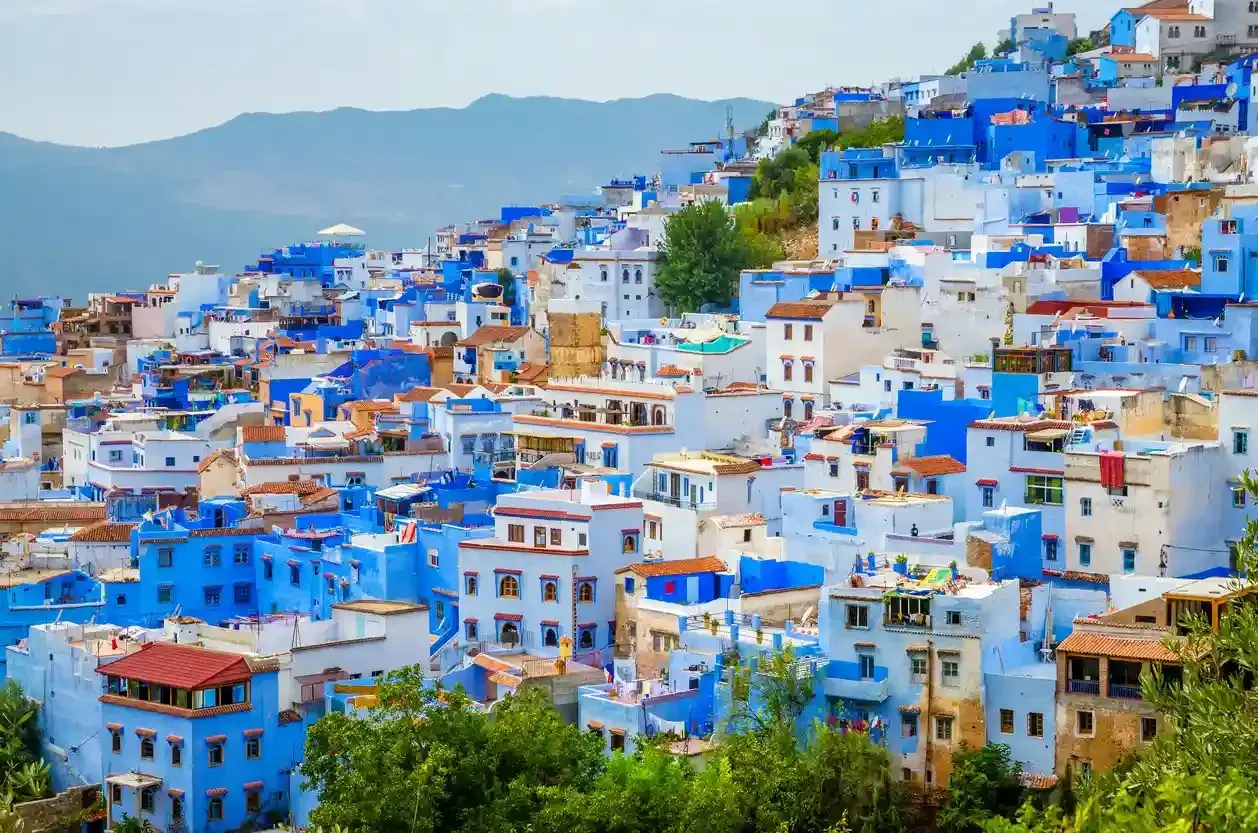
Ever scrolled through Instagram and stopped dead at photos of impossibly blue streets? Or seen those stunning rose-red buildings glowing in golden light? Welcome to Morocco, where entire cities are painted in signature colors so iconic they've become destinations themselves.
I'm talking about Chefchaouen's legendary blue that makes you feel like you're walking on air, Marrakech's terracotta red that seems to pulse with a thousand years of history, and colors so vibrant you'll question whether your eyes are playing tricks on you.
But here's what most travel guides won't tell you: the colors of Morocco aren't just pretty backdrops for your photos. They're a visual language carrying centuries of cultural meaning, spiritual beliefs, and practical wisdom. Understanding what these colors mean transforms Morocco from beautiful scenery into a deeply meaningful journey.
Let me walk you through Morocco's chromatic story from the cultural symbolism behind every shade to the best places to experience Marrakech's colors and beyond. Whether you're planning your trip or just dreaming about it, this is your complete guide to experiencing Morocco's visual magic!
Table Of Contents:
#Why Morocco Looks Like This: The Cultural Story Behind the Colors
#Chefchaouen: The Blue Pearl That Broke Instagram
#Marrakech Colors: The Red City That Glows Like Fire
#Beyond Marrakech & Chefchaouen: Morocco's Other Color Stories
#Understanding Zellij: Morocco's Tile Art Masterpiece
#Colors of Morocco: The Deeper Meaning
Morocco's Color Vocabulary: More Than Just Pretty Shades
Here's the fascinating part: the colors of Morocco aren't random aesthetic choices. They're a carefully preserved cultural dialect that Moroccans have been "speaking" for over a thousand years.
The original six sacred colors:
1- White → Purity, wisdom, divine light
2- Black → Protection (though some families avoid it)
3- Blue → Infinity, serenity, heaven
4- Green → Islam, paradise, fertility
5- Red → Courage, protection from evil
6- Yellow → Decay, endings (used carefully)
Modern expansion: Today's Moroccan artisans use 20+ distinct colors, but they still honor these foundational meanings. You'll see this wisdom everywhere—from the famous zellij tile work covering mosque walls to the clothing locals choose for weddings and funerals.
Why this matters for travelers: Understanding color symbolism helps you appreciate WHY Marrakech is red, WHY Chefchaouen is blue, and WHY you'll see so much green and gold in sacred spaces. It's cultural storytelling through pigment!
Green & Gold: Islam's Sacred Colors
Green holds the highest spiritual position:
- Represents paradise in Islamic teaching
- Symbolizes fertility and prosperity
- Covers saints' shrines (green silk is sacred)
- Decorates mosque tiles and traditional gardens
- Signals divine blessing and spiritual renewal
Gold complements green's sacred nature:
- Material wealth meets spiritual perfection
- Adorns holy spaces to elevate them
- Represents divine prosperity
Where you'll see it: Mosques, religious sites, ceremonial clothing, and traditional gardens. The combination of green tiles with gold accents is quintessentially Moroccan!
White & Black: Spiritual Opposites
White = Ultimate Reverence:
- Wisdom, honor, dignity, purity
- Sufi mystics call it "divine illumination."
- Worn at weddings AND funerals (both sacred transitions)
- Preferred by Prophet Muhammad
- Burial shrouds are always white
Black = Complicated:
- Some families exclude it entirely (spiritual impurity associations)
- Others embrace it as sophisticated and fashionable
- Modern Morocco increasingly accepts black clothing
- Cultural attitudes are evolving
Practical tip: If you're visiting mosques or religious sites, white clothing shows deepest respect. Avoid all-black outfits in traditional areas if you want to blend in culturally.
Ready to Experience Morocco's Colors in Person?
Now that you understand the magic behind the colors of Morocco and Marrakech, it's time to see them with your own eyes!
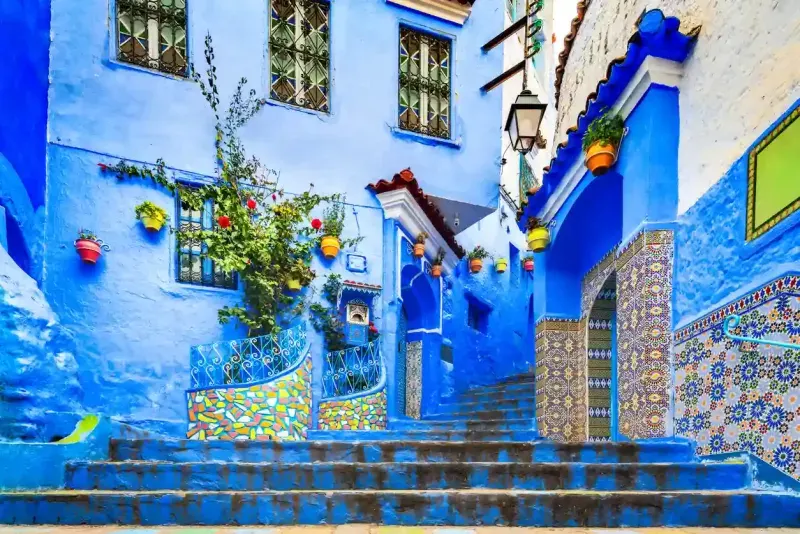
The Blue City of Morocco, Chefchaouen
Why Is Everything BLUE Here?!
Let's solve this beautiful mystery. Chefchaouen, nestled in the dramatic Rif Mountains, is painted in every shade of blue you can imagine (and some you can't).
The origin story (1930s): Jewish refugees fleeing persecution brought a sacred tradition: painting walls brilliant blue as a reminder of heaven. In Jewish religious practice, blue creates a visual pathway to contemplating the divine.
Why it stuck (practical genius + cultural adoption):
- Mosquito repellent: Insects mistake blue walls for water and stay away
- Natural cooling: Blue reflects intense mountain sunlight, keeping interiors cooler
- Aesthetic tribute: Some say it honors the Mediterranean Sea or the Ras el-Maa waterfall
- Islamic symbolism: Blue represents happiness and optimism in Muslim culture
The result? An entire city painted in sapphire, teal, turquoise, ultramarine, indigo, and cobalt. Every. Single. Surface.
When to Visit the Blue Pearl
Spring (March-May): BEST TIME
- Perfect temperatures for walking cobblestone hills
- April-May = absolute peak weather
- Blooming flowers create a stunning contrast against the blue walls
- Comfortable for all-day exploration
Fall (September-November): RUNNER-UP
- Cool, pleasant temperatures
- WAY fewer tourists (peaceful experience)
- Still great for photography
- Ideal for contemplative wandering
Winter (December-February): QUIET SEASON
- Tranquil atmosphere (locals outnumber tourists)
- Occasional rain (bring an umbrella)
- Cooler mountain temps (pack layers)
- Authentic local life is visible
Summer (June-August): HOT & CROWDED
- Skip if possible, intense heat + maximum tourists
- If you must go, visit VERY early morning
Photography Tips: Capturing Chefchaouen's Blue Magic
Best time to shoot:
- 7-9 AM: Golden hour light, zero crowds, soft shadows
- Avoid 11 AM-3 PM (harsh overhead sun washes out blues)
Iconic photo spots:
- Derb El Assri Street: The most photographed blue alley
- Sidi Bouchouka blue stairways: Epic wide shots
- Hidden courtyards (wander to discover!)
Pro composition tricks:
- Wear white or light colors (dramatic contrast against blue)
- Include colorful doors, flower pots, and cats for interest
- Frame shots through archways
- Capture texture variations, each blue shade tells a story
What makes Chefchaouen photos POP: The sheer variety! You'll find deep sapphire next to vibrant teal, luminous turquoise beside rich ultramarine. This isn't one blue, it's a blue SYMPHONY.
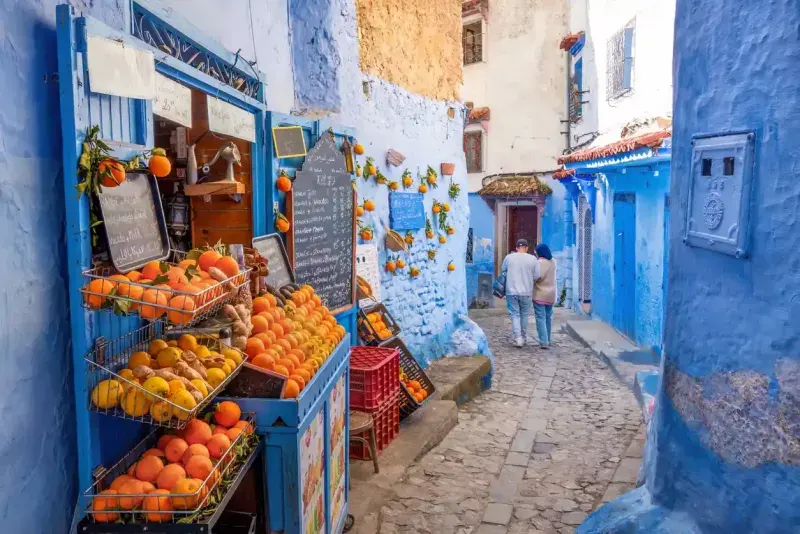
The Blue City of Morocco, Chefchaouen
Customize Your Dream Vacation!
Get in touch with our local experts for an unforgettable journey.
Plan Your Trip
Why Marrakech Is RED (And Why It Matters)
The 12th-century origin: When the Almohad dynasty rebuilt Marrakech, they used pisé, an ancient rammed earth construction method. The local soil from the Haouz Plains contains HIGH iron oxide, which creates that distinctive warm reddish-brown color naturally.
The genius? This wasn't just aesthetic, it was SMART:
- Local materials = sustainable building
- Red clay = excellent thermal properties (stays cool!)
- Iron oxide = natural preservation
- Consistent color = unified city identity
The result: Nearly a THOUSAND years later, Marrakech still glows rose-red at sunset like a city made of fire.
Where to see the best Marrakech colors:
- Koutoubia Mosque: The quintessential red sandstone icon
- Saadian Tombs: Intricate tile work against red walls (restoration perfection!)
- City walls: Especially stunning during golden hour
- Traditional riads: Interior courtyards showcase red clay + colorful tiles
- Majorelle Blue: Marrakech's OTHER Iconic Color
Majorelle Blue: Marrakech's OTHER Iconic Color
Wait, Marrakech has ANOTHER signature color?
The story: French artist Jacques Majorelle created his legendary garden in 1924, painting everything in an extraordinarily intense cobalt blue he later trademarked as "Majorelle Blue."
His inspiration:
- Traditional Moroccan ceramic tiles
- Flowing Berber robes
- Painted kasbah window frames
The plot twist: Fashion icon Yves Saint Laurent bought the property in 1980, preserving this electric blue oasis in the heart of the Red City.
What makes it special: Majorelle Blue creates STUNNING contrast against Marrakech's ochre architecture. Critics describe the famous lily pool as "Monet meets Matisse" impressionistic beauty with bold color experiments.
Photo tip: The juxtaposition of electric blue against terracotta red makes for incredibly striking images!
Marrakech Souks: A Kaleidoscope Explosion
The medina souks are where Marrakech colors go absolutely WILD:
Souk Semmarine:
- Embroidered kaftans in jewel tones
- Ceramics stacked in rainbow towers
- Textiles glowing with saturated colors
Souk El Attarine (Spice Market):
- Perfect pyramids of saffron (golden yellow)
- Paprika mountains (deep red)
- Cumin hills (warm brown)
- Turmeric peaks (bright orange)
The sensory overload is REAL and incredible!
Souk Smata (Babouche Market):
- Traditional Moroccan slippers in EVERY color combination
- Electric pink, sunshine yellow, emerald green, royal purple
- Handcrafted leather goods
Souk Haddadine (Metalwork Quarter):
- Brass lanterns catching light
- Copper pots gleaming
- Silver jewelry sparkling
- Sound of hammers creating a rhythm
Pro tip: Visit early morning (8-10 AM) for best light streaming through souk roofs, fewer crowds, and more willing artisans happy to chat!
How Light Transforms Marrakech Colors
Here's where Marrakech colors become MAGIC:
The geographic advantage: Marrakech's position creates extraordinary North African light that photographers dream about.
Throughout the day:
Dawn (6-8 AM):
- Soft pink glow on red walls
- Long shadows through narrow medina streets
- Gentle, diffused light is perfect for photos
Midday (11 AM-3 PM):
- INTENSE light (harsh for photos but dramatic!)
- Sharp geometric shadows through mashrabiya screens
- Textural details of ancient walls pop
Golden Hour (5-7 PM):
- Red walls literally GLOW like fire
- Warm amber light on terracotta
- Most magical time (don't miss this!)
Blue Hour/Night:
- Lanterns illuminate souks
- Colored tiles shimmer
- Romantic, mysterious atmosphere
Why it matters: The same wall looks completely different at dawn vs. sunset. Plan your photography around these transformations!
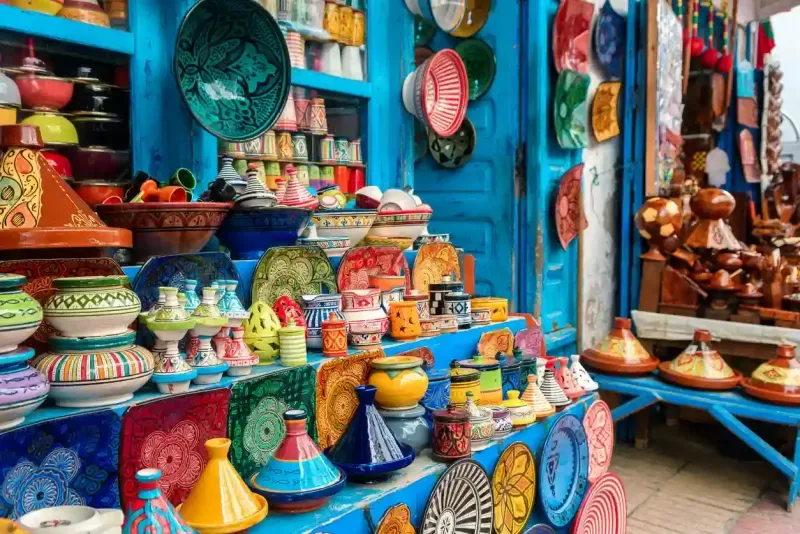
Colorful crockery at moroccan shop
Fez: The Blue Ceramic Capital
What makes Fez special: This ancient imperial city (founded 789 AD!) is Morocco's pottery headquarters.
The signature: Distinctive cobalt blue ceramics that define Fes throughout the Islamic world.
What they make:
- Intricate zellij tiles
- Ornate decorative plates
- Ceremonial bowls
- Functional tagines
The process: Local clay + vibrant blues/emerald greens/lustrous golds + hand-painting techniques passed through generations. The firing intensifies blue hues through mineral oxidation, creating those impossibly rich tones.
Don't miss: Chaouwara Tanneries (operating for 1,000 years!) with rows of ancient stone vats filled with natural dyes:
- Poppy flowers (reds)
- Indigo plants (blues)
- Henna leaves (oranges/browns)
The smell is INTENSE (bring mint leaves for your nose!), but the visual of all those colored dye vats is STUNNING.
Morocco's economic capital earned "White City" status from brilliant whitewashed buildings stretching along the Atlantic coast.
The vibe: Modern metropolis balancing contemporary urban development with traditional Moroccan architecture through predominant white facades.
What white represents here:
- Ocean light reflection
- Coastal elegance
- Cultural heritage meets modernity
- Clean, fresh Mediterranean aesthetic
The Atlas Mountains: Ochre Villages Rising from Earth
Berber settlements in the Atlas Mountains display nature's perfect camouflage:
The colors: Warm reddish, ochre, and earth-tone palettes
Why: Adobe dwellings built from the SAME red clay soil they sit on
The effect: Villages seem to GROW from the landscape organically
These echo Marrakech colors because they share geological origins that iron-rich red clay defines Morocco's heartland.
Bonus: Spring brings wildflowers, adding purple, yellow, and pink bursts across 2,500 kilometers of dramatic mountain terrain!
Sahara Desert: Golden Sands That Change Color
The Sahara's color metamorphosis throughout each day is MIND-BLOWING:
- Sunrise: Delicate pink tones
- Midday: Brilliant white OR deep golden (depends on mineral composition)
- Sunset: Rich red and copper shades
Why do different colors exist?
- Golden sand: Quartz minerals
- Pink/red sand: Iron-rich minerals (oxidized over geological time)
- White sand: Limestone, gypsum, ancient salt deposits
- Black sand: Volcanic rock and basalt
Photo tip: The Sahara is a chameleon for sunrise/sunset shoots for the most dramatic colors!
Essaouira: Coastal Blue & White Harmony
This Atlantic port city (UNESCO World Heritage!) showcases:
The palette: Pristine whitewashed buildings + vivid blue shutters/doors/accents
Why blue? Practical genius! Fishermen originally painted boats blue to:
- Blend with the sea waters
- Avoid startling fish populations
The spread: This practical choice gradually became tradition, appearing throughout the community until blue defined Essaouira's identity alongside white.
The vibe: Laid-back coastal elegance, artistic atmosphere, windy beaches, fresh seafood!
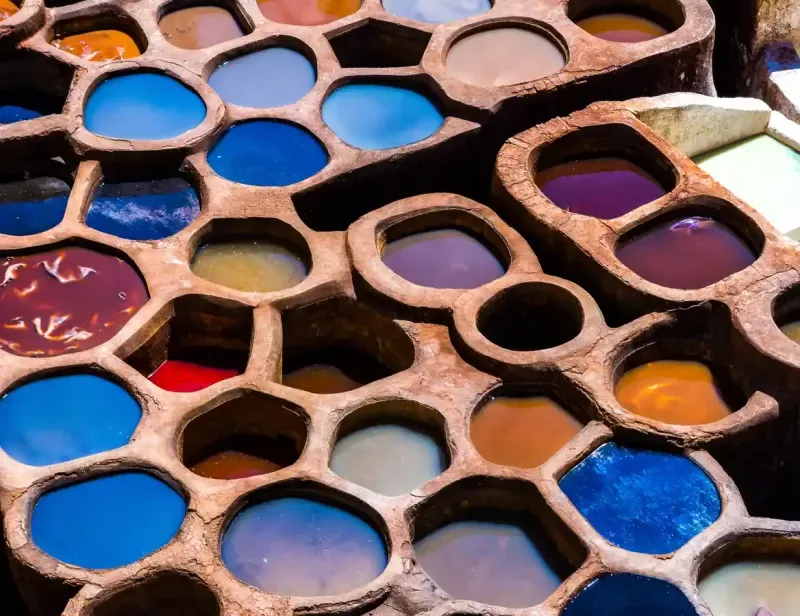
Old tanks of the Fez's tanneries with color paint for leather, Morocco
You'll see zellij EVERYWHERE in Morocco, but what IS it?
Definition: Hand-cut glazed ceramic mosaic technique from medieval Andalusia (12th century)
The process:
1- Master craftsmen (maallems) use specialized tools (menkach)
2- Shape each tile piece into precise geometric forms
3- Follow patterns established CENTURIES ago
4- Fit pieces together like intricate puzzles
Traditional palette:
- Cobalt blue
- Emerald green
- Golden yellow
- Pure white
Where you'll see it:
- Mosque walls and floors
- Riad courtyards
- Palace interiors
- Fountains
- Decorative friezes
Why it's incredible: These geometric patterns have symbolic meanings, mathematical precision, and artistic beauty all created BY HAND, piece by tiny piece!
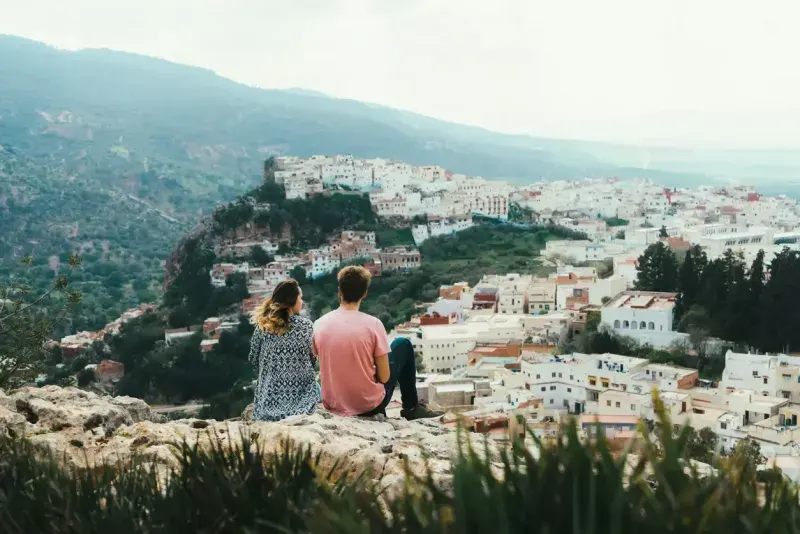
Scenic view of Moulay Idriss Zerhoun
Here's what I want you to understand: Morocco's extraordinary palette isn't just Instagram-worthy scenery. It's a living cultural language that continues guiding:
- Daily decisions (what to wear, how to decorate)
- Spiritual practices (which colors for which sacred spaces)
- Architectural choices (maintaining identity through consistent palettes)
- Artistic expression (preserving ancestral techniques)
- Collective memory (colors = cultural storytelling)
When you walk Chefchaouen's blue streets or watch sunset illuminate Marrakech's red walls, you're not just seeing pretty colors. You're witnessing centuries of cultural evolution, religious devotion, and communal identity expressed through pigment.
That's the magic of Morocco.
The colors of Morocco aren't decoration, they're TESTIMONY to a nation whose identity remains inseparably linked to the hues defining its most cherished places.
And now you understand the language they speak!
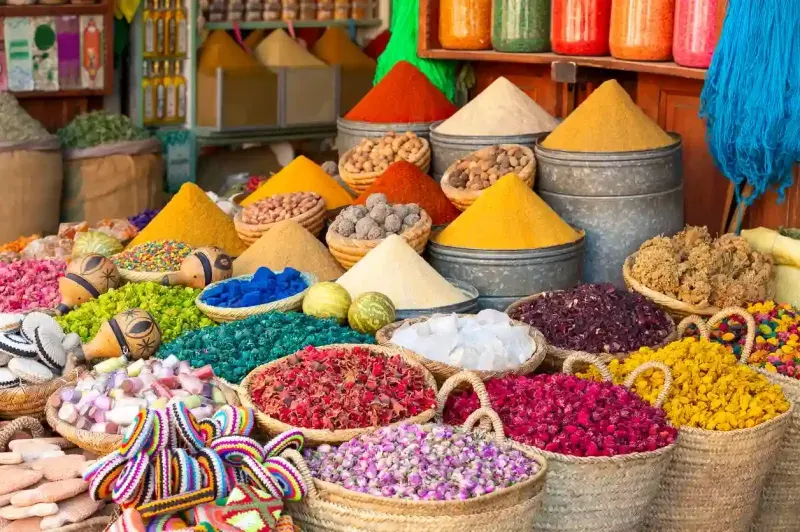
Colorful spices and dyes found at souk market in Marrakesh, Morocco.
Conclusion
Morocco's chromatic tapestry weaves narratives that transcend mere visual documentation, demanding direct encounter to fully appreciate their profound cultural resonance. The firsthand experience of these magnificent hues fundamentally alters one's perception of how deeply intertwined culture, ancestral traditions, and spiritual beliefs remain within contemporary Moroccan society. Each destination, from Chefchaouen's celestial blue passages to Marrakech's warm terracotta embrace, and the ever-shifting golden expanses of the Sahara, presents its own distinctive form of visual eloquence that speaks directly to the human spirit.
The traveler who walks these chromatic landscapes discovers that Morocco's extraordinary palette serves as far more than architectural decoration or artistic expression. These colors function as living testimonies to centuries of cultural evolution, religious devotion, and communal identity. They represent a visual language that continues to guide daily decisions, influence spiritual practices, and preserve the collective memory of a nation whose identity remains inseparably linked to the very hues that define its most cherished places.
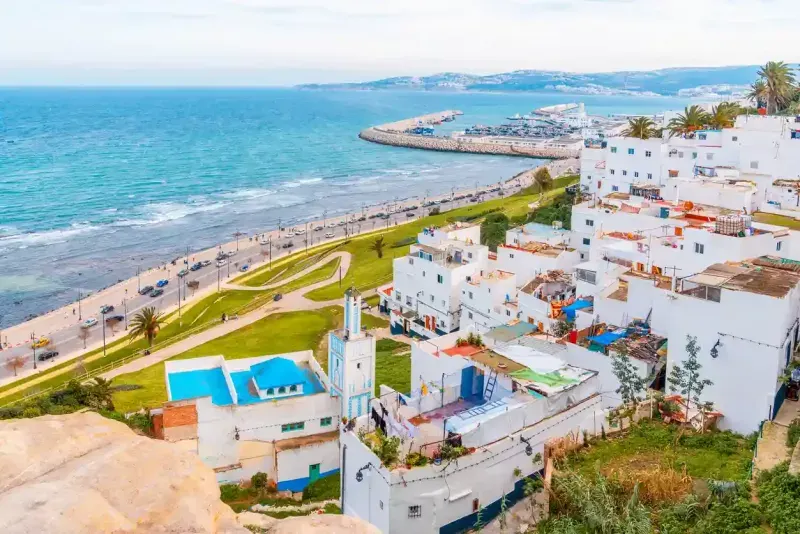
Scenic Cityscape of Tanger City
What is the national color of Morocco?
Morocco's national color is red. I'll see it on the Moroccan flag (red background with green star). Red represents courage, strength, and protection. Green is equally important as Islam's sacred color. Together, red and green are Morocco's most significant national colors.
What does the color blue mean in Morocco?
Blue represents infinity, serenity, heaven, and happiness in Moroccan culture. In Islamic tradition, blue symbolizes the divine. It also has practical uses: repels mosquitoes and reflects sunlight for cooling. I'll see blue in Chefchaouen streets, Fes ceramics, and Majorelle Garden.
What colors are inspired by Morocco?
Morocco-inspired colors include: Marrakech red/terracotta, Chefchaouen blue, Majorelle blue (intense cobalt), Sahara gold, Atlas ochre, Mediterranean white, mint green, saffron yellow, and bougainvillea pink. These form the "Moroccan palette" used worldwide in design and fashion.
Why is Morocco so colorful?
Morocco is colorful because colors carry deep cultural and spiritual meanings. Each city has signature colors: Marrakech's red clay, Chefchaouen's blue streets, Fes's cobalt ceramics. Islamic art emphasizes vibrant zellij tiles. Diverse landscapes golden Sahara, green mountains, and blue coast, inspire architectural colors. Centuries of Berber, Arab, and Andalusian influences created this chromatic richness.
What is Morocco's color?
Morocco's signature color is red (national flag and Marrakech), but Morocco is known for multiple iconic colors: red (Marrakech), blue (Chefchaouen), white (Casablanca), ochre (Atlas Mountains), and gold (Sahara). Rather than one color, Morocco represents a complete palette where each region has distinctive hues.
What is Moroccan blue called?
The most famous is "Majorelle Blue" an intense cobalt trademarked by artist Jacques Majorelle in Marrakech. Chefchaouen blue refers to azure shades in the Blue Pearl village. Fes blue describes deep cobalt in traditional ceramics. Generic terms include "Moroccan cobalt" or "Islamic blue."
What are the 12 colour names?
The 12 basic color names are: red, orange, yellow, green, blue, purple, pink, brown, black, white, gray, beige. Traditional Moroccan decorative arts used six fundamental colors: white, black, blue, green, red, and yellow—these appear in historic zellij tile work.
What are white Moroccans called?
They're simply called "Moroccans." Morocco doesn't use racial color descriptors for citizens. Morocco's population includes diverse Arab-Berbers, Arabs, and Amazigh/Berbers with skin tones ranging from very light to dark. Moroccan identity is based on citizenship and culture, not racial categories. European expatriates are called "foreigners" or "expats," not "white Moroccans."