
 Home
Home
Cairo's northern quarters harbor one of the medieval Islamic world's most intriguing architectural marvels—Al-Hakim Mosque, a colossal structure whose construction unfolded across two remarkable decades between 990 CE and 1013 CE. This extraordinary religious monument began its journey under Caliph al-'Aziz, whose architectural vision would ultimately find completion through his successor, the enigmatic al-Ḥākim.
The sheer magnitude of this sacred edifice commands immediate attention. Stretching across approximately 120.78 meters by 113.01 meters, the mosque dwarfs its contemporary, the renowned al-Azhar Mosque. Such monumental proportions demanded vast resources—al-Hakim invested 40,000 dinars for construction and 5,000 more for furnishings. The resulting masterpiece presents a rectangular courtyard embraced by graceful arcades, supported by sturdy piers, built predominantly from brick yet adorned with elegant stone facades.
Centuries have tested this fortress-like sanctuary, yet Al-Hakim Mosque endures with remarkable tenacity, surviving earthquakes and political upheavals. The structure's most captivating features are its distinctive minarets, rising from the north and west corners, each anchored by square bases. These elements reveal connections to earlier Egyptian mosque traditions, particularly those observed in Fustat and Qatai’, echoing the design principles of the Congregational Mosque of Ibn Tulun.
The Founding and Early History of Al-Hakim Mosque
The year 990 CE marked the start of an ambitious architectural endeavor spanning decades and witnessing the rise of two rulers. Fifth Fatimid Caliph al-Aziz Billah conceived the project, motivated by the overcrowded Al-Azhar Mosque. Fate prevented al-Aziz from seeing his vision complete, as he died in 996 CE.
Construction under Caliph al-Aziz and al-Hakim
Power passed to eleven-year-old al-Hakim bi-Amr Allah, who rekindled the mosque project around 1002-1003 CE under the supervision of Abu Muhammad al-Hafiz 'Abd al-Ghani ibn Sa'id al-Misri. Initially named Al-Anwar—“the shining one”—the mosque eventually took its current designation in honor of al-Hakim. Construction demanded substantial financial and material resources. By 1010 CE, al-Hakim had implemented critical design modifications, including angled minarets and extended interior columns for structural support.
Inauguration and early use in 1013 CE
Partial prayer services began as early as 991 CE, but the official inauguration occurred in Ramadan 1013 CE after a 22-year construction period. Al-Hakim established the mosque as a “Jami’” or congregational mosque, integrating it with Al-Azhar to serve both worshippers and students.
Integration into Cairo's city walls
The mosque’s northern sections, including minarets, became part of Cairo's defensive walls between Bab al-Futuh and Bab al-Nasr under Fatimid vizier Badr al-Jamali (1087–1092 CE), creating a unique hybrid structure where sacred architecture also served strategic military purposes.
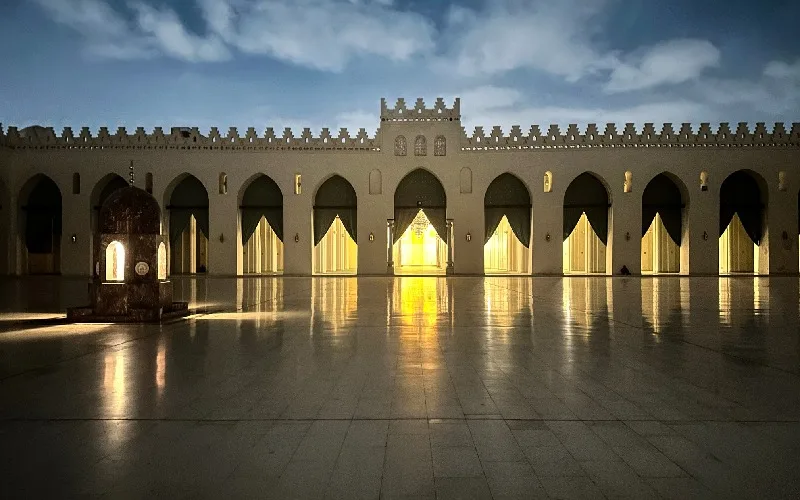
Al-Hakim Mosque was constructed between 990 CE and 1013 CE. It was initiated by Caliph al-Aziz Billah and completed by his son, Caliph al-Hakim bi-Amr Allah.
Architectural Features of Al-Hakim Mosque
The mosque features an irregular rectangular configuration, Cairo's second-largest after Ibn Tulun Mosque, blending Fatimid design with longstanding Egyptian mosque traditions.
Layout and courtyard design
At the heart lies a 78 by 66-meter central courtyard (sahn) surrounded by four covered arcades (riwaqs), arranged asymmetrically. The eastern qibla side extends through five bays, the western flank two, and the northern and southern sides three each. Thirteen entrances provide access, including two through the qibla wall.
The unique projecting entrance portal
The northwestern facade presents a 15.5-meter-wide portal projecting 6 meters from the mosque, soaring 11 meters high. Twin towers guard the entrance, featuring recessed panels and intricate Kufic calligraphy inspired by the Great Mosque of Mahdiya in Tunisia.
Prayer hall and mihrab structure
The prayer hall’s five parallel arcades are intersected by a transverse aisle, emphasizing orientation toward Mecca. Originally crowned with three domes, only the central dome above the mihrab remains. The mihrab sits beneath a semi-circular dome resting on carefully crafted squinches.
Use of stone, brick, and marble
The mosque combines stone for exterior walls and minarets with brick for interior arches and domes. Interior elements include stucco friezes with Kufic script, decorative wooden tie-beams, and marble accents added in later restorations.
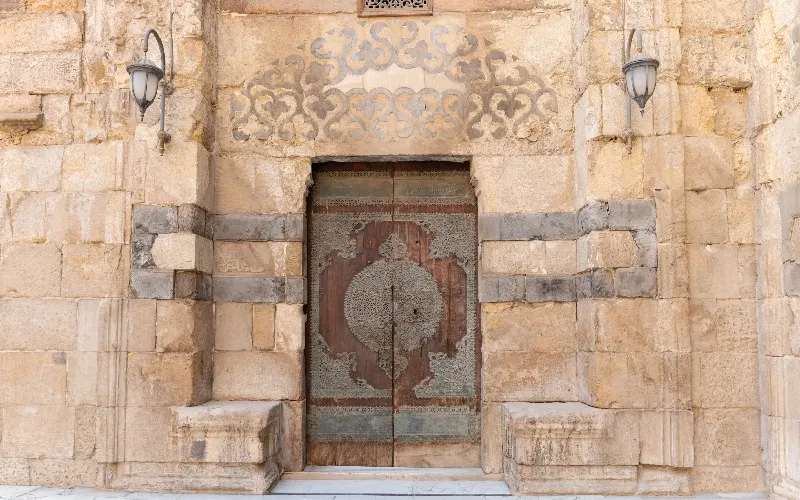
The mosque features a spacious central courtyard, a distinctive projecting entrance portal, and unusual minarets that were later encased in square bastions. It also incorporates a mix of stone and brick construction.
The Minarets: Design, Alteration, and Symbolism
The twin minarets at the north and west corners are among the mosque’s most notable features, reflecting both architectural innovation and political symbolism.
Original multi-tiered minarets
Completed in 1003 CE, the northern minaret transitions from square to cylindrical, the southern from square to octagonal, both crafted from ashlar stone.
Encasement in square bastions
In 1010 CE, al-Hakim enclosed both minarets in square brick bastions connected by arches. The northern minaret was later integrated into Cairo’s city fortifications by Badr al-Jamali.
Inscriptions and decorative elements
The minarets originally featured ornamental bands and inscriptions in foliated Kufic script, emphasizing Fatimid sovereignty and aesthetic mastery.
Theories behind the concealment
Scholars debate al-Hakim’s motives—some suggest political reasons tied to Fatimid claims over Mecca and Medina; others cite theological shifts away from orthodox Isma’ili positions.
Mamluk-era reconstruction after earthquake
The 1303 CE earthquake destroyed upper minaret sections, reconstructed under Sultan Baybars II with Mamluk-style octagonal bodies, muqarnas decoration, and ribbed domes, diverging from original Fatimid aesthetics.
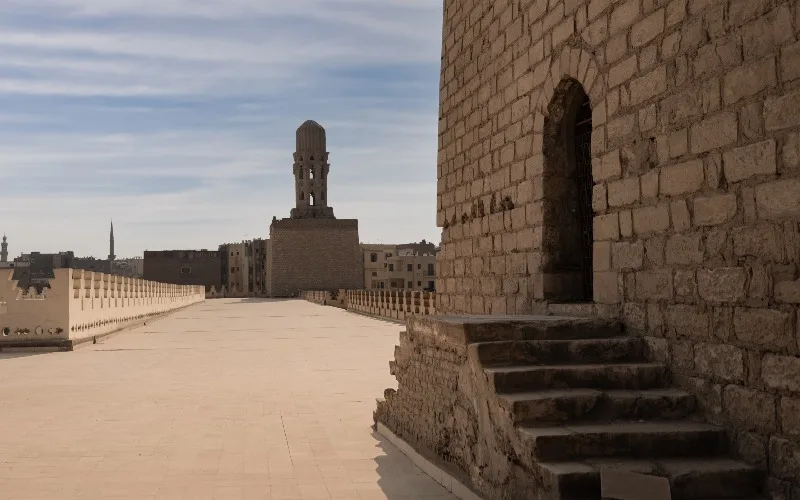
During the reign of Caliph al-Mustansir, the northern section of the mosque, including its minarets, was incorporated into Cairo's defensive wall, effectively making it part of the city's fortifications.
Customize Your Dream Vacation!
Get in touch with our local experts for an unforgettable journey.
Plan Your TripRestoration and Modern Relevance
Neglect reduced the mosque to ruins until modern restoration efforts revived it.
20th century Dawoodi Bohra restoration
In 1937, Syedna Taher Saifuddin discovered the mosque in decay, inspiring a 27-month reconstruction (1980) led by Mohammed Burhanuddin. Original stucco carvings, timber tie-beams, and Quranic inscriptions were meticulously preserved, with new marble and gold enhancements.
Criticism and debate over authenticity
Scholars questioned whether such extensive material replacements maintained authenticity. Proponents argue the restoration saved the mosque and created a functional worship space.
21st century restoration efforts
In 2017, a joint project by the Dawoodi Bohra community and the Egyptian government addressed environmental challenges including air pollution, rising water levels, humidity, and structural cracks. Completed in 2023 at a cost of 85 million EGP, the project secured the mosque’s stability.
Recent visits and renewed attention
The 2023 reopening drew international recognition, including a visit by Indian Prime Minister Narendra Modi alongside Egypt’s Prime Minister. The mosque now functions as both an active place of worship and a cultural monument.
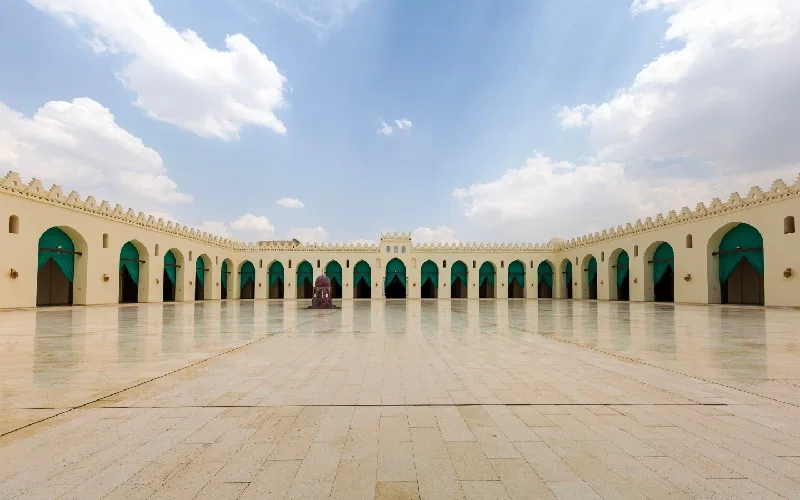
The mosque has undergone several restorations, notably by the Dawoodi Bohra community in the 20th century and a recent government-backed project completed in 2023, addressing environmental threats and structural issues.
Today, Al-Hakim Mosque functions as both an active prayer site for worshippers and a cultural landmark, attracting visitors interested in its historical and architectural significance.
Al-Hakim Mosque embodies Fatimid architectural mastery and religious devotion. Its minarets, defensive integration, and centuries-spanning construction chronicle Cairo’s urban, political, and religious evolution. Despite neglect, restoration efforts have preserved its historical and spiritual significance. Today, the mosque bridges modern visitors with medieval Islamic achievements, reflecting the enduring legacy of Cairo’s architectural and cultural heritage.
Al-Hakim Mosque represents one of the largest and most important Fatimid-era mosques in Cairo, reflecting the architectural and political ambitions of the Fatimid caliphs.
It is larger than Al-Azhar Mosque and second in size only to Ibn Tulun Mosque in Cairo, showcasing unique design elements like its projecting portal and bastioned minarets.
Earthquakes, particularly in 1303 CE, damaged the minarets and parts of the structure, leading to Mamluk-era reconstructions that altered the original Fatimid design.
The mosque combines stone for exterior walls and minarets with brick for interior arcades and domes, while marble, stucco, and wood decorate its interiors.
Yes, the mosque features Kufic inscriptions, floral motifs on wooden tie-beams, and elaborate stucco panels reflecting Fatimid artistic traditions.


The Great Pyramids of Giza, Egypt’s iconic monuments, showcase ancient engineering brilliance and remain the last wonder of the ancient world, continuing to fascinate visitors and researchers alike.

The Egyptian Museum in Cairo houses over 170,000 ancient artifacts, including Tutankhamun's complete collection and golden death mask. Opened in 1902, it's the world's largest repository of Egyptian antiquities.

Khan el-Khalili is Cairo’s legendary medieval bazaar, where centuries-old Islamic architecture, vibrant trade, and timeless cafés create a living cultural landmark.

The Great Sphinx of Giza, with its lion body and pharaoh head, represents ancient Egyptian artistry, symbolic power, and enduring cultural fascination.

Tanoura is a traditional Egyptian Sufi dance known for its colorful spinning skirts, spiritual rhythm, and deep roots in ancient mystic traditions.

Saqqara, Egypt's ancient necropolis, features Djoser's Step Pyramid—the world's oldest. Spanning 3,000 years, it preserves royal tombs and sacred animal burials.

The Valley Temple at Giza, built 2570 BCE by Khafre, features 16 granite columns and hosted sacred afterlife rituals. Explore Fourth Dynasty architecture.

The Citadel of Cairo is a historic medieval fortress and royal complex, showcasing centuries of Egyptian power, Mamluk architecture, and Islamic heritage, now preserved as a UNESCO World Heritage Site.

Khufu's Solar Boat is a 142-foot cedar vessel discovered 1954 near the Great Pyramid. Built without nails 4,500 years ago, it's now at Grand Egyptian Museum.

St. George Church in Old Cairo, founded 684 AD, features unique circular design, sacred healing relics & underground chapel linked to the Holy Family's refuge.

Pyramids Sound and Light Show transforms Giza into open-air theater with 50 minutes of narration, music & lighting bringing ancient Egyptian history alive.

The Djoser Pyramid at Saqqara is Egypt's first pyramid, built 2600 BCE by architect Imhotep. Standing 62.5m tall, it reopened to visitors in 2020.

The Hanging Church in Old Cairo is a 1,300-year-old Coptic sanctuary built on Babylon Fortress. Free entry, open daily 9 AM-5 PM, dress modestly required.
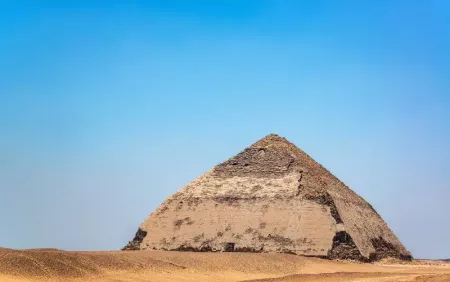
The Bent Pyramid at Dahshur features a rare bent profile created by ancient construction adjustments, offering insight into Egypt’s earliest attempts at smooth-sided pyramids.

Coptic Cairo features 4th-century churches and recent tomb discoveries revealing early Christian heritage. Explore the Hanging Church, Abu Serga & sacred sites.
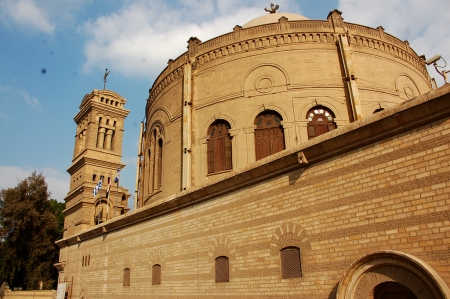
Saint Barbara’s Church in Coptic Cairo is one of Egypt’s oldest Christian monuments, dating back to the 5th–6th century. Known for housing the relics of Saint Barbara, the church reflects centuries of Coptic heritage, architectural evolution, and deep spiritual significance.

Explore the Fortress of Babylon, a major Roman fort in Old Cairo known for its strategic location, massive towers, and enduring historical significance.
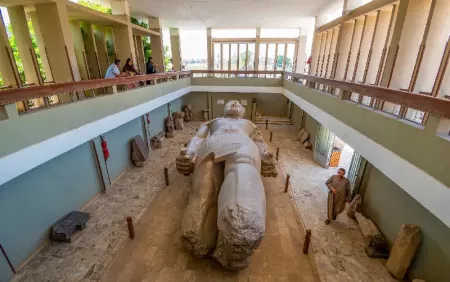
Memphis Necropolis is Egypt’s ancient royal burial site, home to pyramids, tombs, and monuments that reflect the early development of pharaonic civilization.
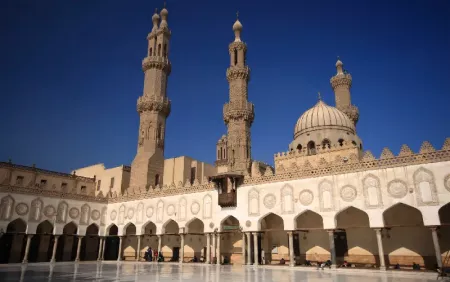
Al-Azhar Mosque is a landmark of Islamic scholarship and Fatimid architecture, home to the world’s second-oldest university and a symbol of Cairo’s spiritual heritage.
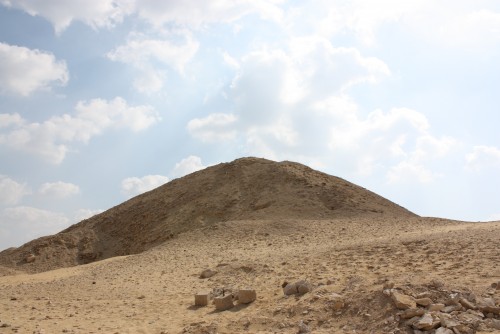
Teti’s Pyramid in Saqqara is an Old Kingdom monument built for the first king of the Sixth Dynasty. Known for its Pyramid Texts and unique mortuary chapel, it remains one of Egypt’s most historically important royal tombs.
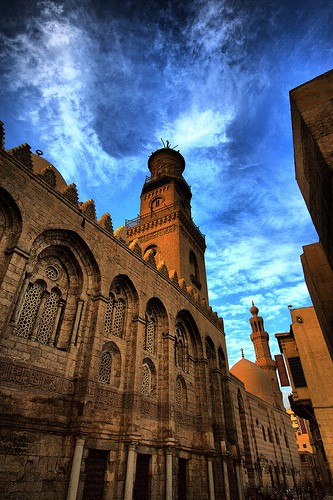
Al Muizz Street is one of Cairo’s oldest and most vibrant historic avenues, showcasing centuries of Islamic architecture. Lined with mosques, palaces, and bustling markets, it offers a captivating walk through Egypt’s medieval past.
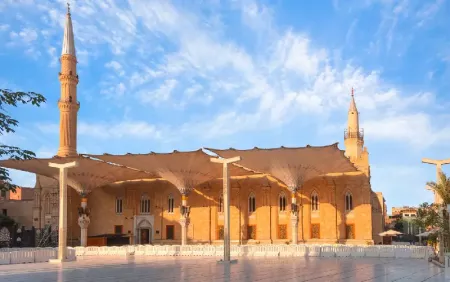
Al-Hussein Mosque is one of Cairo’s most sacred Islamic landmarks, built in 1154 and revered for housing the head of Imam Hussein. Located by Khan El-Khalili, it blends centuries of architectural heritage and remains a major pilgrimage site.
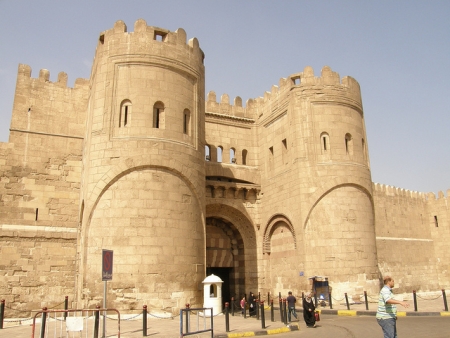
Bab al-Futuh is an 11th-century Fatimid gate in Old Cairo, famous for its massive round towers and strategic role in the city’s medieval fortifications.
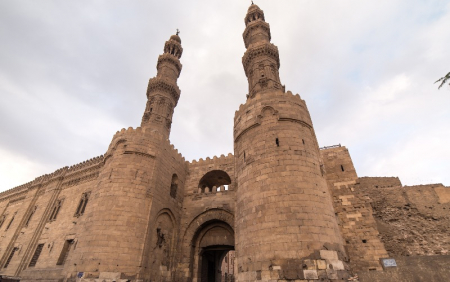
Bab Zuweila is one of Cairo’s last surviving medieval gates, built in 1092 CE by the Fatimid vizier Badr al-Jamali. Famous for its towering twin bastions, massive wooden doors, and later Mamluk minarets, it served as a defensive stronghold, execution site, and ceremonial gateway. Today, it stands as one of Cairo’s most iconic historic monuments.
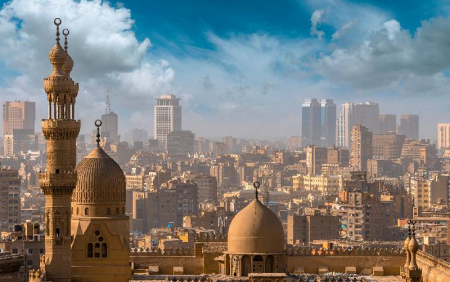
Al Rifai Mosque in Cairo blends Neo-Mamluk architecture with royal history. Completed in 1912, it serves as both a majestic mosque and mausoleum for Muhammad Ali’s family.
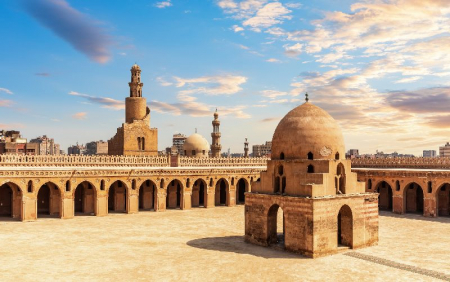
The Ibn Tulun Mosque, Cairo’s oldest well-preserved mosque, dates back to 879 CE. Famous for its vast square layout, intricate arches, and 128 ornate stucco windows, it remains a pinnacle of early Islamic architecture and a must-visit historical landmark.
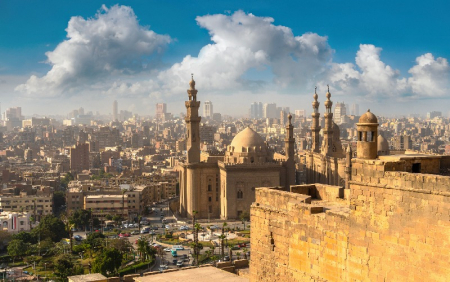
The Sultan Hassan Mosque, built in the 14th century, is a Bahri Mamluk architectural marvel in Cairo, renowned for its grand portal, extensive madrasas, and historic significance.
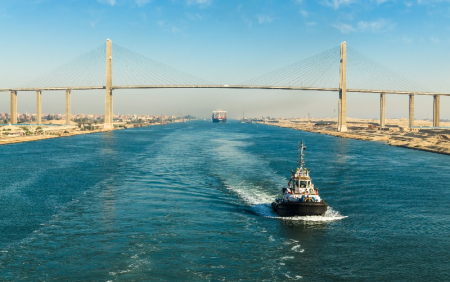
The Suez Canal, Egypt’s iconic waterway, connects Africa and Asia, handling thousands of ships yearly and shaping international trade.
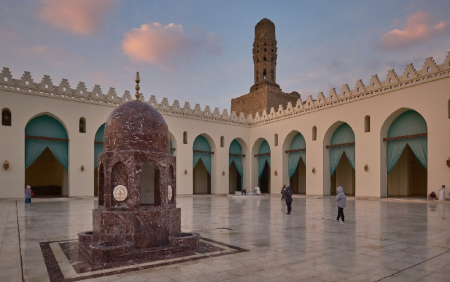
Al-Hakim Mosque, Cairo, is a stunning Fatimid-era mosque built between 990–1013 CE. Famous for its grand courtyard, distinctive minarets, and rich history, it remains a key cultural and religious landmark.
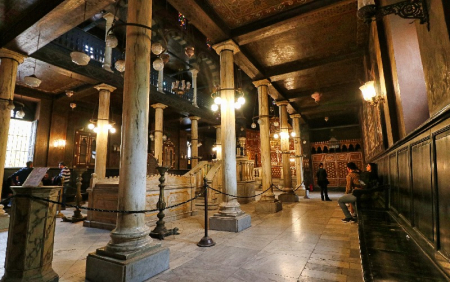
The Ben Ezra Synagogue, founded in the 11th century in Old Cairo, is Egypt’s oldest Jewish monument and the discovery site of the renowned Cairo Geniza.