
 Home
Home
Desert landscapes across Egypt rarely echo with the sound of falling water, yet 65 kilometers southwest of Fayoum lies a striking exception: Wadi El Rayan, the country’s only site where true waterfalls surge through arid terrain. Covering 1,759 km², this protected reserve is a fusion of shimmering twin lakes, rolling dunes, and thriving wildlife—an oasis that stands in dramatic contrast to the surrounding Sahara.
The story behind this landscape is as surprising as the scenery itself. What visitors admire today began not as a natural event, but as a bold engineering project in 1973. Fayoum’s growing agricultural sector was producing more drainage water than Lake Qarun could safely hold. To prevent flooding, engineers redirected runoff into the deep desert depression of Wadi El Rayan. This intervention gradually formed two vast lakes: the Upper Lake (50.90 km²) and the Lower Lake (62.00 km²), totaling roughly 113 km² of open water. Where they meet, water spills from one basin to the next, creating the celebrated Wadi El Rayan Waterfalls—Egypt’s largest and only significant waterfalls, immortalized in cinema and art.
Yet the true wonder of Wadi El Rayan extends beyond scenery. Designated a protectorate in 1989, the region now shelters wildlife of rare global significance. Most notably, it hosts the world’s only remaining population of the slender-horned gazelle, alongside eight other mammal species such as the fennec fox and dorcas gazelle. Along the water’s edge, reeds and vegetation attract migratory birds, turning the lakes into a vital winter refuge teeming with biodiversity.
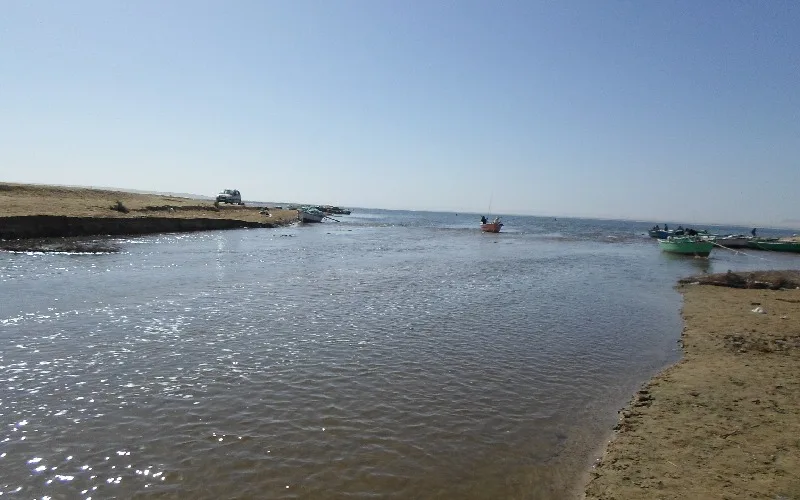
How Wadi El Rayan was shaped by human intervention
Before its transformation, the Wadi El Rayan depression was an enormous, empty basin plunging 43–64 meters below sea level. Its low elevation made it the ideal candidate for a new drainage system when Fayoum’s agricultural boom created excess water that traditional channels could no longer manage.
The need for a new drainage basin
By the early 1970s, Lake Qarun faced dangerously rising levels. To protect farmland, officials sought a new outlet for agricultural drainage water. The Wadi El Rayan depression—unused and geologically capable of holding vast amounts of water—offered a practical and promising alternative.
Construction of canals and tunnels
In 1973, engineers began crafting what became one of Egypt’s most impressive desert infrastructure projects. They carved a 9 km open canal and tunneled an 8 km passage through desert rock, ultimately creating a link that funnels 0.25 km³ of drainage water annually, with a salinity of roughly 1 gram per liter. This system successfully diverted excess water into the desert, turning a potential agricultural disaster into a catalyst for new ecosystems.
Formation of upper and lower lakes
Water first entered the depression in 1973, slowly building the Upper Lake, which stabilized around 5 meters below sea level by 1978. Overflow then moved southward through a marshy channel to form the Lower Lake, fully established by 1980.
The lakes continue to shift with time. The Upper Lake remains relatively stable, while the Lower Lake gradually shrinks—losing nearly 1.92 million m² per year. At their meeting point, a drop in elevation creates the waterfalls for which the reserve is famous, with cascades reaching 20 meters in height. Despite pressures from modern land reclamation and water reuse projects, the lakes remain a thriving ecological hub.
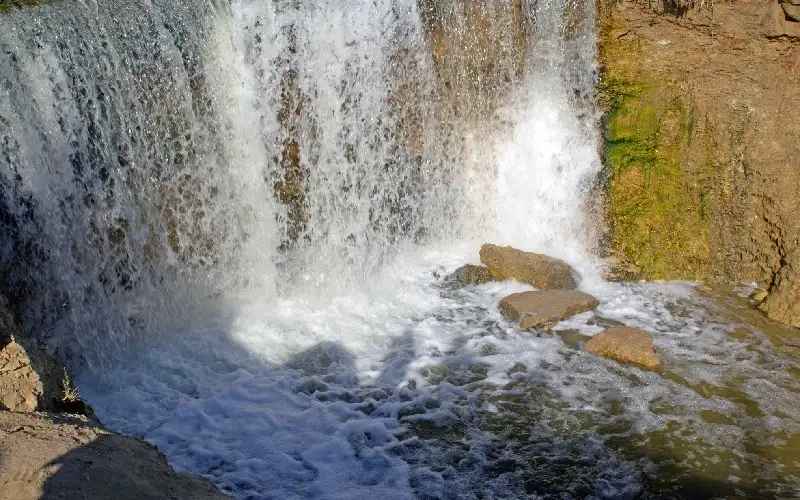
Wadi El Rayan was artificially created in 1973 as part of a water management project. Engineers constructed canals and tunnels to divert excess agricultural drainage water from the Fayoum region into a desert depression, forming two lakes and creating the unique ecosystem we see today.
The waterfalls of Wadi El Rayan
The waterfalls are the reserve’s most iconic feature—a rare intersection of geology and engineering.
Why they are Egypt's only waterfalls
Egypt’s geography offers few natural elevation changes conducive to waterfalls, especially within desert environments. In Wadi El Rayan, however, the higher northern lake feeds the lower southern one, creating a natural downward flow. This elevation difference, shaped by human-made channels and erosion, results in the only real and large-scale waterfalls in Egypt.
How erosion created the cascades
Over decades, flowing water carved channels through sandstone ridges, gradually sculpting the waterfalls visitors admire today. Their continuous flow enriches local habitats, supporting aquatic plants, fish, birds, and mammals. The cascades also add ecological complexity, strengthening the area’s protected status.
The future of the waterfalls as lake levels rise
Because the waterfall’s existence depends on the height difference between the lakes, rising or equalizing water levels may eventually cause the cascades to vanish. Environmental officials acknowledge this ephemeral nature yet emphasize the site’s enduring scientific, ecological, and tourism value. The waterfalls remain a symbol of how engineered landscapes can evolve into genuine natural treasures.
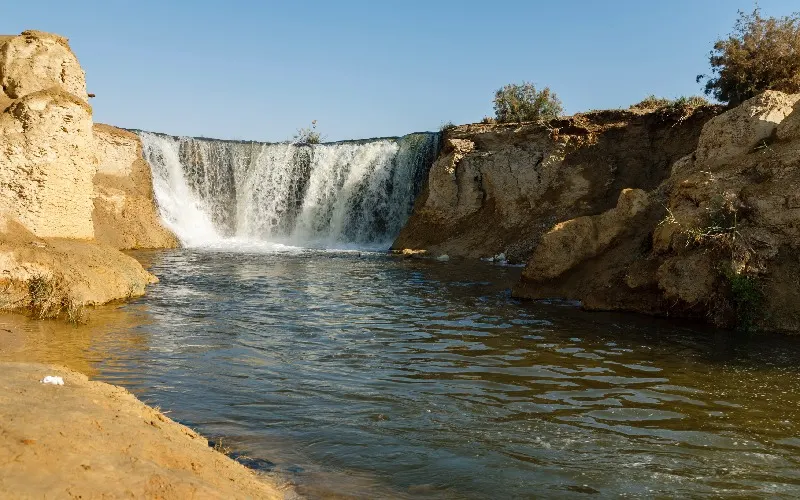
The waterfalls at Wadi El Rayan are significant because they are Egypt's only natural waterfalls. Created by the flow between two man-made lakes, these cascades are a rare geographical feature in Egypt's predominantly desert landscape.
Customize Your Dream Vacation!
Get in touch with our local experts for an unforgettable journey.
Plan Your TripBiodiversity and conservation efforts
Wadi El Rayan is one of Egypt’s richest biological refuges, home to unusual wildlife adapted to desert and wetland environments.
Slender-horned gazelle and other mammals
The slender-horned gazelle, critically endangered and uniquely adapted to the Sahara, represents the reserve’s most precious inhabitant. These delicate, pale creatures travel in small family groups of 3–4, typically led by a single male. Alongside them, researchers have recorded nine mammal species, including fennec foxes, Rüppell’s foxes, and dorcas gazelles.
Bird species and seasonal migration
The lakes attract an impressive range of birdlife: 13 resident species and 26 migratory species. The wetlands provide safe resting grounds and abundant food during long migration cycles. In 2025, researchers recorded a major discovery—the first confirmed Booted Warbler sighting in Egypt since 1993—highlighting the area's scientific significance.
Role of the protectorate in ecological preservation
Since becoming a protectorate in 1989, Wadi El Rayan has benefited from targeted conservation initiatives. The “Green Road” project, for example, planted 250 trees to strengthen regional biodiversity and rehabilitate surrounding landscapes. Ongoing research and environmental programs aim to protect both flora and fauna while promoting sustainable ecotourism.
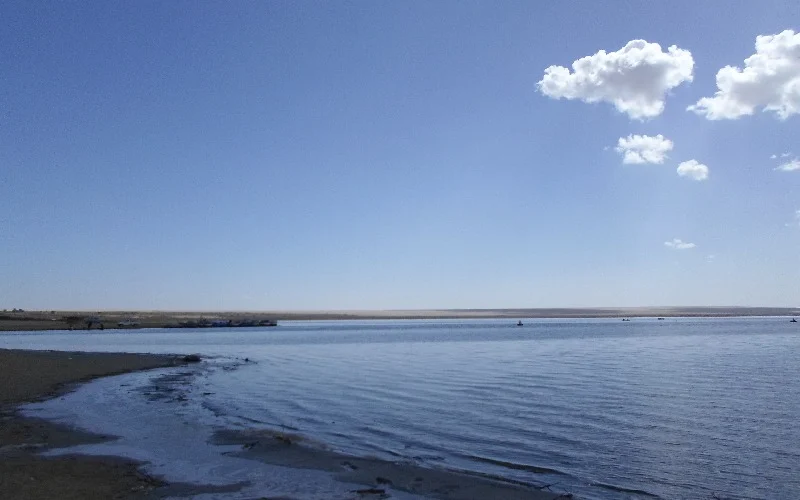
Visitors to Wadi El Rayan may encounter rare and endangered species such as the slender-horned gazelle, fennec fox, and Rüppell's fox. The area is also a paradise for bird watchers, with over 39 species of resident and migratory birds, making it an ideal location for wildlife observation.
Fossils and ancient life in Wadi El Hitan
Within the broader Wadi El Rayan region lies one of Earth’s most extraordinary paleontological sites: Wadi Al-Hitan (Valley of the Whales), a UNESCO World Heritage site and the richest repository of early whale fossils in the world.
Discovery of early whale fossils
First uncovered in 1902–03 by Hugh J. L. Beadnell and colleagues, the fossils were originally classified as “Zeuglodon,” later renamed Basilosaurus. Accessibility improved in the 1980s, allowing scientists to uncover thousands of new specimens.
Scientific importance of the site
Today, Wadi Al-Hitan contains around 1,000 well-documented fossil whale skeletons. In 2015, researchers discovered the world’s only fully intact Basilosaurus, preserved with its last meal still inside—crabs, sawfish, and a small whale. The site includes fossils from four classes, 15 families, and 25 genera of ancient vertebrates.
What fossils reveal about Earth's history
Basilosaurus isis and Dorudon atrox dominate the fossil landscape, offering a rare window into the late Eocene epoch, 37–40 million years ago. Their skeletons feature tiny preserved hind limbs—powerful evidence of whales' evolutionary journey from land to sea. Additional finds include sea turtles, sharks, rays, sirenians, and the earliest known fossil pelican.
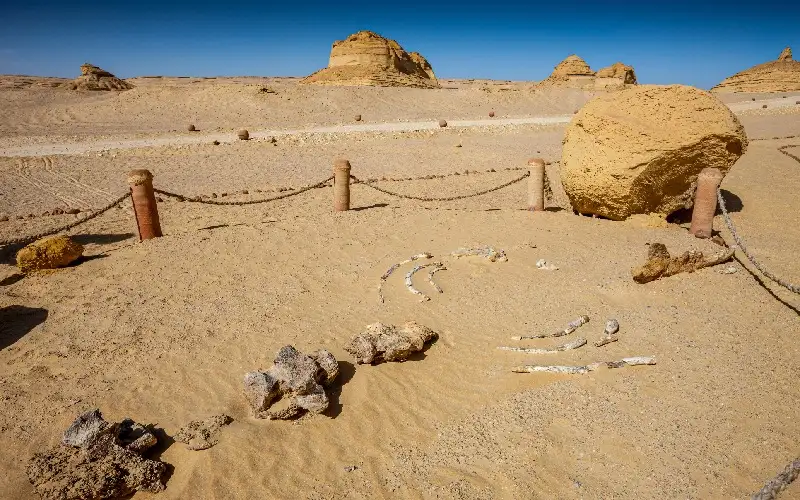
Wadi Al-Hitan, also known as the Valley of the Whales, is a UNESCO World Heritage Site within Wadi El Rayan. It contains the world's largest concentration of whale fossils, including complete skeletons of ancient whales with vestigial limbs. These fossils provide crucial evidence of whale evolution from land to sea mammals, making it an invaluable site for paleontological research.
Wadi El Rayan stands as a remarkable testament to how human intervention, natural forces, and time can collaborate to form unexpected wonders. What began as a practical solution to an agricultural drainage challenge has become one of Egypt’s most biologically and geologically valuable landscapes.
The lakes support endangered gazelles, migratory birds, fish, and desert-adapted mammals. The waterfalls—temporary yet iconic—demonstrate how engineered systems can evolve into natural marvels. Meanwhile, Wadi Al-Hitan extends the region’s significance back millions of years, revealing extraordinary chapters of Earth’s evolutionary story.
Though the waterfalls may eventually disappear, Wadi El Rayan’s ecological, scientific, and cultural value endures—an ever-evolving sanctuary at the heart of Egypt’s desert.
Absolutely. Wadi El Rayan is a family-friendly destination offering open spaces, scenic viewpoints, and calm lakeshores ideal for picnics and group outings. Families can explore the waterfalls, take nature walks, and enjoy safe outdoor activities while learning about Egypt’s unique desert ecology.
Yes, Wadi El Rayan offers various recreational activities. Visitors can enjoy swimming in the lakes, observing the waterfalls, and learning about the area's ecology at the visitor center. The protected area is popular for both leisure and educational purposes.
Wadi El Rayan is highly accessible, located approximately 90 minutes from Fayoum City and around 2.5 hours from Cairo. The route is well-marked, and many tour operators offer day trips and guided visits.
While there are no hotels inside the protected area, several eco-lodges, desert camps, and guesthouses are available in nearby Fayoum. These accommodations provide visitors with authentic desert experiences and proximity to major attractions like Tunis Village and Wadi Al-Hitan.
Yes. Wadi Al-Hitan lies within the Wadi El Rayan Protected Area, and many tours include both destinations. Visitors can explore Wadi El Rayan’s lakes and waterfalls, then continue to Wadi Al-Hitan to discover ancient whale fossils and learn about Earth’s prehistoric marine life.
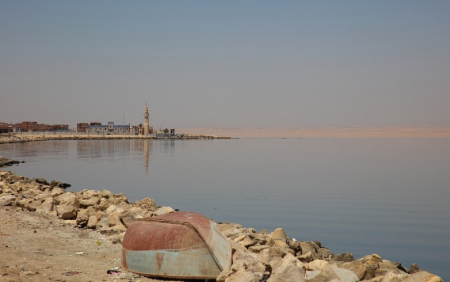
Lake Moeris, the ancient giant of the Faiyum Oasis, once spanned over 1,200 km² and powered Egypt’s irrigation system. Today known as Lake Qarun, it remains a historic symbol of engineering and agricultural innovation.
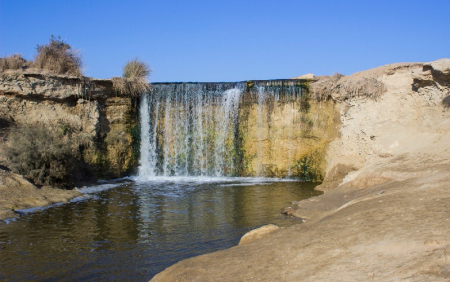
Wadi El Rayan is a breathtaking desert sanctuary in Fayoum, home to Egypt’s only waterfalls, expansive twin lakes, and globally rare wildlife like the slender-horned gazelle. Formed through a 1973 water diversion project, it now stands as one of Egypt’s most remarkable protected natural habitats.
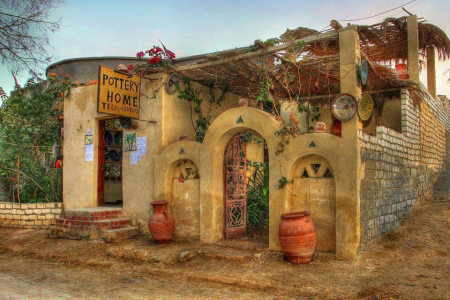
Tunis Village in Egypt’s Fayoum Oasis is a world-famous center for pottery and rural arts. Sparked by Evelyne Porret’s pottery school in 1980, it has grown into a vibrant artistic community, hosting an annual pottery festival and attracting visitors with its creative charm and proximity to Wadi Hitan.