
 Home
Home
Covering nearly 40,000 square meters, the complex reflects a rare synthesis of Egyptian religious tradition, Greek influence, and Roman imperial patronage. The imposing façade stretches 139 feet wide and rises 60 feet high, supported by six massive Hathor-headed columns. Inside, eighteen towering columns fill the hypostyle hall, their surfaces richly carved with reliefs and inscriptions. Sacred rituals, healing practices, and astronomical observation all converged here, making Dendera both a spiritual and scientific center.
Among the temple’s most famous features is the Dendera Zodiac, an extraordinary celestial map carved in stone, alongside richly decorated astronomical ceilings that reveal the advanced cosmic knowledge of ancient Egyptian priests. Together, these elements elevate the Temple of Hathor beyond architecture into a living record of religious belief, artistic mastery, and scientific inquiry.
The Temple of Hathor at Dendera is renowned for its exceptional preservation, intricate astronomical ceilings, and being one of the best-preserved temple complexes in Egypt. It's also famous for its unique architectural features and religious significance.
The Historical Evolution of the Dendara Temple
From Old Kingdom roots to Greco-Roman expansion
The sanctity of Dendera stretches back more than 6,000 years, making it one of Egypt’s oldest religious centers. Archaeological evidence confirms cult activity as early as 4000 BCE. The earliest architectural remains date to the Old Kingdom, when Pepi I of the Sixth Dynasty initiated construction around 2250 BCE, later completed by his successor Merenre I.
Successive dynasties expanded the site. During the Middle Kingdom, Mentuhotep II erected monuments still preserved in museum collections today. The New Kingdom, particularly the Eighteenth Dynasty, continued renovations, reinforcing Dendera’s importance across Egypt’s golden ages.
Influence of Ptolemaic and Roman rulers
The present-day temple primarily reflects Ptolemaic ambition. The earliest surviving structure, a mammisi (birth house), was built under Nectanebo II, Egypt’s last native pharaoh. Construction of the Temple of Hathor itself began under Ptolemy XII, with Cleopatra VII completing much of the decoration around 20 BCE. Reliefs show Cleopatra and her son Caesarion, emphasizing her political strategy of aligning herself with Egypt’s ancient religious traditions.
Roman emperors continued the work. Tiberius added the monumental hypostyle hall, while Trajan, Nero, and Domitian contributed additional structures and reliefs, blending Roman imperial imagery with Egyptian religious symbolism.
Preservation through centuries of sand cover
Following the rise of Christianity in the 4th century CE, the temple was abandoned and briefly repurposed as a Coptic church. Over time, desert sands buried the complex, shielding it from weathering and vandalism. When European explorers uncovered Dendera in the 19th century, they revealed a site astonishingly well preserved, with original colors still visible. Modern conservation efforts, resumed in 2017, continue to restore and reveal the temple’s ancient brilliance.
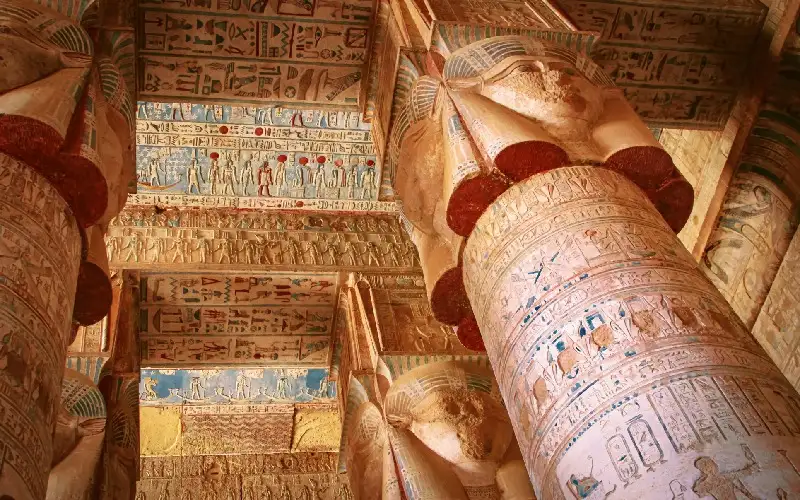
Construction of the main temple began in 54 BCE during the late Ptolemaic period, under the reign of Ptolemy Auletes. However, the site has a much longer history, with evidence of worship dating back to around 4,000 BCE.
Inside the Temple of Hathor: Architecture and Design
Unlike many Egyptian temples, Dendera lacks a traditional pylon entrance, allowing visitors to enter directly into its sacred interior.
The hypostyle halls and their celestial ceilings
The great hypostyle hall, built under Emperor Tiberius, features 24 columns, each crowned with Hathor-headed capitals shaped like the sacred sistrum. Above, the ceiling displays detailed astronomical scenes depicting solar cycles, lunar phases, and constellations. Traces of deep blue and gold pigment remain, offering rare insight into the temple’s original appearance.
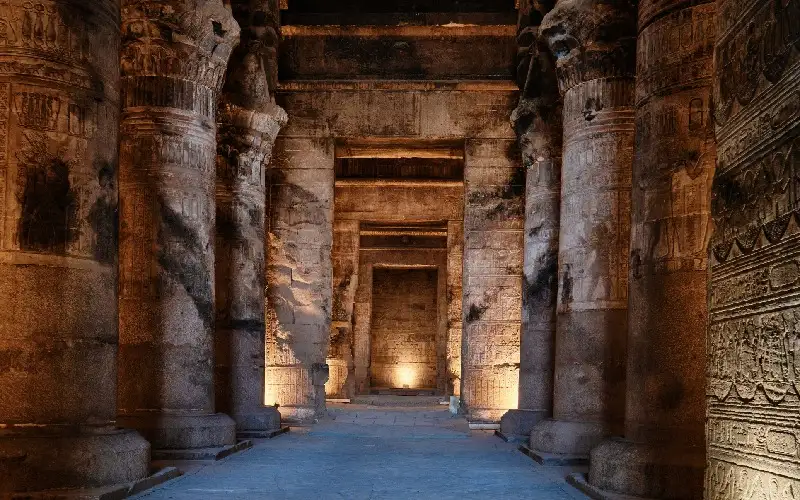
Beyond lies a smaller hypostyle hall, or Hall of Appearances, supported by six columns. This space served as the ceremonial stage where Hathor’s statue emerged during festivals, surrounded by chambers for incense, offerings, and ritual objects.
The sanctuary and sacred barque shrine
At the temple’s core stood the sanctuary, once housing Hathor’s gilded cult statue within a wooden naos. Only priests and the pharaoh could enter this sacred space. Surrounding chapels honored related deities, while priests carried Hathor’s image in a ceremonial barque during processions, allowing worshippers brief contact with the goddess.
Staircases, roof chapels, and the Pure Place
Two staircases formed a ritual circuit to the roof. Reliefs along the western staircase depict priests ascending with sacred emblems, while the eastern staircase marked descent. On the roof, chapels dedicated to Osiris symbolized death and rebirth, while the Pure Place allowed Hathor’s statue to greet the rising sun at the New Year. Beneath the temple floor, 14 crypts safeguarded sacred treasures and hosted secret rituals.
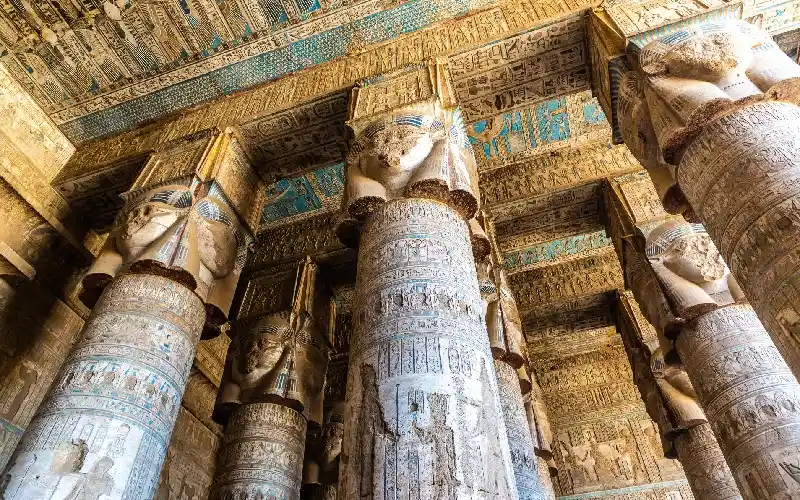
The Temple of Hathor features massive Hathor-headed columns, richly decorated hypostyle halls, hidden crypts beneath the floors, and rooftop chapels dedicated to Osiris. Unlike many Egyptian temples, it lacks a traditional pylon entrance, allowing direct access into the interior spaces.
Customize Your Dream Vacation!
Get in touch with our local experts for an unforgettable journey.
Plan Your TripReligious and Cultural Significance of the Temple
Hathor as goddess of love, music, and healing
Dendera served as the principal cult center of Hathor, goddess of love, beauty, music, fertility, motherhood, and joy. Worship emphasized celebration—music, dance, and laughter were sacred acts. Sistrums, harps, and drums filled the temple during rituals, reflecting Hathor’s role as “Lady of Jubilation.”
Healing rituals and the temple's sanatorium
The temple complex included a sanatorium, where pilgrims sought divine healing. Sacred water poured over magical stelae absorbed healing power before being consumed by the sick. Many stayed overnight, hoping Hathor would appear in dreams and grant cures.
Festivals and processions in ancient times
The most important celebration was the Beautiful Reunion, symbolizing Hathor’s union with Horus of Edfu, representing fertility and cosmic balance. Processions of gilded barques, music, and communal celebration transformed Dendera into a vibrant religious center. The Feast of Drunkenness commemorated a myth where Hathor saved humanity, emphasizing joy as a divine force.
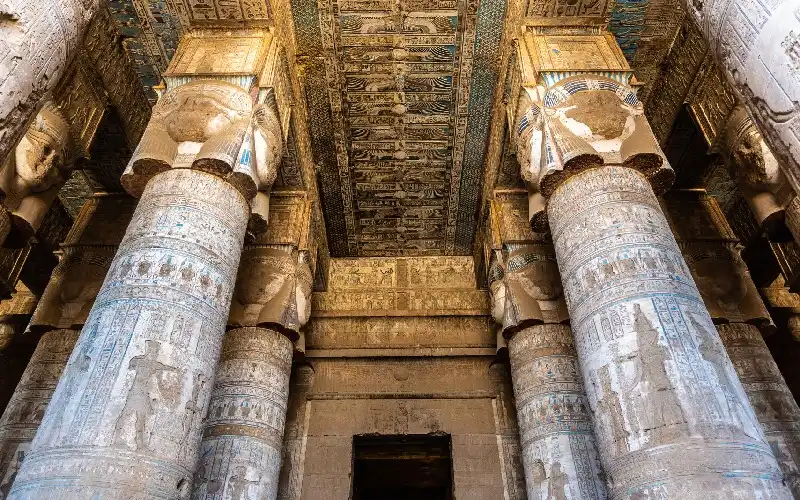
Hathor was a major goddess in ancient Egyptian religion, associated with love, beauty, music, dance, fertility, and motherhood. She was known as "the mistress of life" and was widely worshiped, with the Temple of Hathor at Dendera serving as her principal cult center.
Mysteries and Interpretations of the Temple of Hathor Egypt
The Dendera Light: myth or technology?
One of Dendera’s most debated reliefs resembles a modern light bulb, complete with a serpent-like filament. Known as the Dendera Light, alternative theorists propose advanced ancient technology. Egyptologists, however, interpret it as symbolic imagery of Harsomtus, a form of Horus emerging from a lotus, consistent with Egyptian creation mythology.
The Zodiac of Dendera and its cosmic map
The famous Dendera Zodiac, now housed in the Louvre, is the only complete circular star map from ancient Egypt. It combines Egyptian and Greco-Roman constellations and dates to around 50 BCE, demonstrating Egypt’s sophisticated astronomical knowledge.
Front-facing sculptures of Hathor and Bes
Unusually, figures of Hathor and the protective deity Bes appear front-facing, breaking Egyptian artistic convention. These images likely served protective and ritualistic functions, reinforcing the temple’s role in safeguarding sacred mysteries.
Symbolic use of light and shadow in temple design
Astronomical imagery of Nut, solar disks, and celestial journeys integrates architecture with cosmic symbolism. Light entering the temple at specific times reinforced the connection between divine order and earthly ritual.
The Dendera Zodiac is a famous astronomical bas-relief found in the temple complex. It's considered the only complete map of an ancient sky, featuring familiar constellations alongside Egyptian celestial symbols. The original is now housed in the Louver Museum in Paris.
The Temple of Hathor at Dendera stands as one of ancient Egypt’s most extraordinary achievements. Preserved by desert sands, it offers an unparalleled glimpse into the spiritual, artistic, and scientific world of antiquity. Its layered history—from Old Kingdom origins to Ptolemaic and Roman grandeur—mirrors Egypt’s cultural evolution across millennia.
More than a monument, Dendera functioned as a living religious center of healing, celebration, and cosmic understanding. Its celestial ceilings, ritual spaces, and enduring mysteries continue to challenge and inspire modern scholarship. The Temple of Hathor remains a timeless bridge between humanity, divinity, and the stars.
The remarkable preservation of the Temple of Hathor is largely due to its burial under desert sand for centuries. After being abandoned in the 4th century CE, wind-blown sand gradually covered the structures, protecting them from weathering and human interference until its rediscovery in the 19th century.
The temple contains fourteen underground crypts used to store sacred objects, ritual equipment, and divine statues. These crypts also hosted secret religious ceremonies and feature some of the most detailed and symbolic reliefs in the entire complex.
Yes, visitors can climb the temple’s staircases to reach the roof, where chapels dedicated to Osiris are located. The rooftop also offers panoramic views and showcases reliefs depicting religious processions and astronomical symbolism.
The “Dendera Light” refers to reliefs in the crypts that resemble modern light bulbs. While some speculate about ancient electrical technology, Egyptologists explain these images as symbolic representations of the god Harsomtus emerging from a lotus flower, rooted in Egyptian creation mythology.
Absolutely. Due to its exceptional preservation, clear carvings, and manageable layout, the Temple of Hathor at Dendera is one of the most accessible and visually impressive sites in Egypt, making it ideal for both first-time visitors and seasoned travelers.

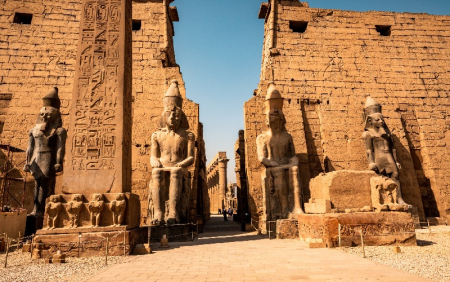
Luxor Temple, built by Amenhotep III and expanded by Ramses II, is a breathtaking New Kingdom monument dedicated to the renewal of kingship. Located on Luxor’s east bank, it stands as one of Egypt's most iconic sanctuaries, celebrated for its grand pylons, colossal statues, and deep religious significance.
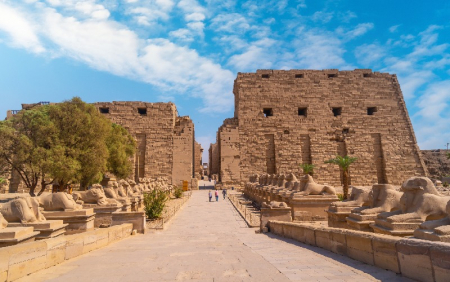
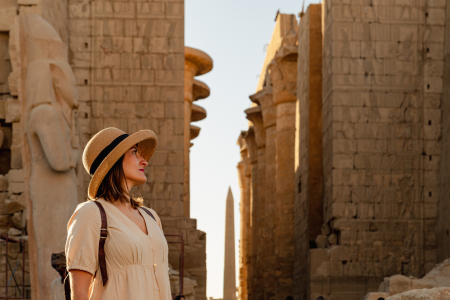
Karnak Temple in Luxor is an iconic ancient Egyptian complex, showcasing grand architecture, rich history, and the spiritual and political legacy of Thebes across nearly 2,000 years of construction.
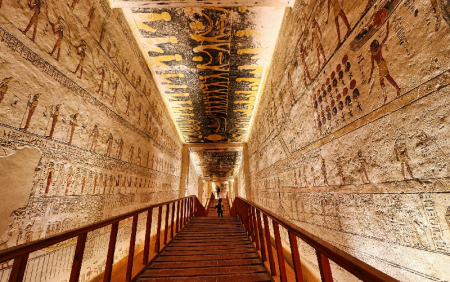
The Valley of the Kings is Egypt’s legendary royal necropolis, featuring 65 tombs of New Kingdom pharaohs, remarkable engineering, and world-famous discoveries like Tutankhamun’s burial.
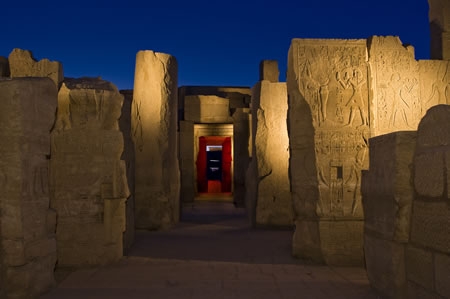
The Karnak Sound and Light Show transforms the vast temple complex into a magical nighttime spectacle, combining illuminated monuments, music, and storytelling to bring ancient Egyptian history vividly to life.
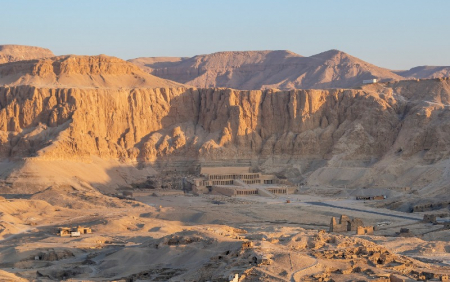
Discover the Valley of the Queens in Luxor, Egypt, with royal tombs, stunning art, and UNESCO heritage significance.
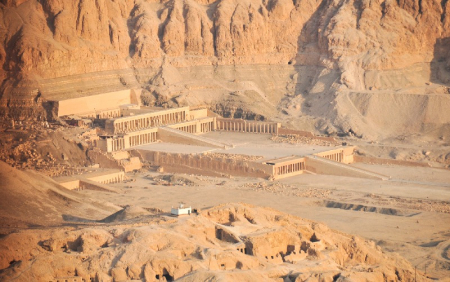
The Temple of Hatshepsut is a breathtaking 18th-Dynasty mortuary temple at Deir el-Bahari, famed for its grand terraces, cliffside design, and historical significance.
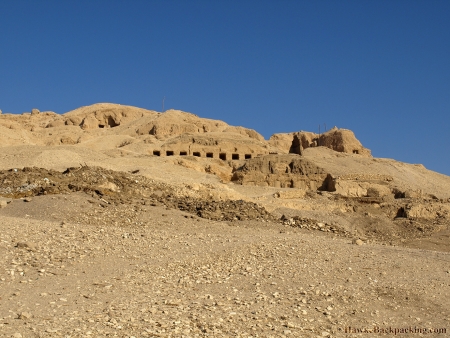
Explore the Valley of the Nobles in Luxor and learn how its 400+ tombs reveal vivid scenes of daily life and remarkable artistry from ancient Egypt’s New Kingdom.
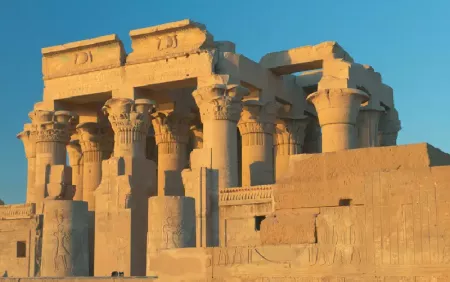
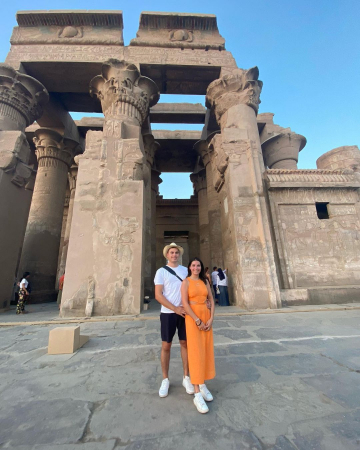
Kom Ombo Temple—Egypt’s remarkable twin sanctuary honoring Sobek and Haroeris, famed for its perfect symmetry and sacred crocodile traditions.
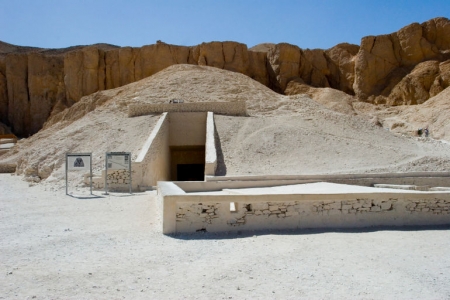
Tutankhamun’s tomb revealed over 5,000 stunning treasures, from gold chariots to the iconic mask, reshaping our understanding of ancient Egypt after its discovery in 1922.

Dendera Temple, 60km from Luxor, is Egypt's remarkably preserved healing sanctuary for Hathor. Explore vivid colors, hidden crypts & ancient astronomical knowledge.
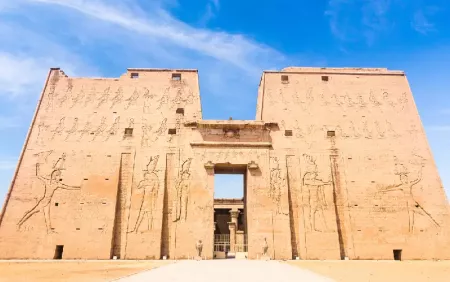
The Temple of Edfu, buried for centuries, is one of Egypt’s best-preserved temples—offering a vivid look into Ptolemaic religion, mythology, and architecture.
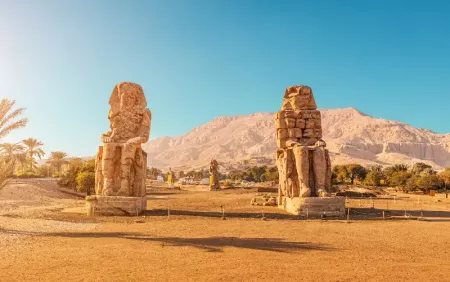
The Colossi of Memnon are 18-meter statues of Amenhotep III, once famed for their mysterious dawn “singing,” which captivated ancient visitors and inspired over a hundred inscriptions.
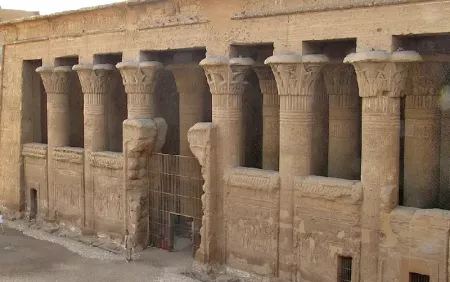
The Temple of Khnum at Esna, built from the Ptolemaic to Roman periods, features a stunning hypostyle hall with 24 ornate columns and reflects centuries of devotion to the creator god Khnum.
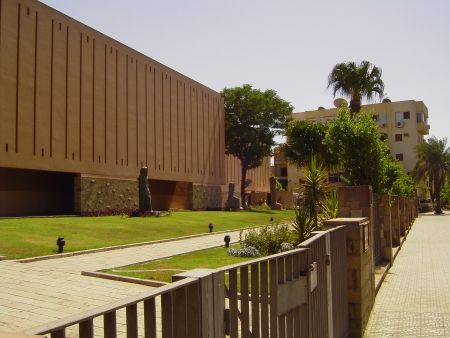
Luxor’s Mummification Museum offers an immersive look at ancient embalming methods, displaying tools, human and animal mummies, and the notable mummy of Masaharta.
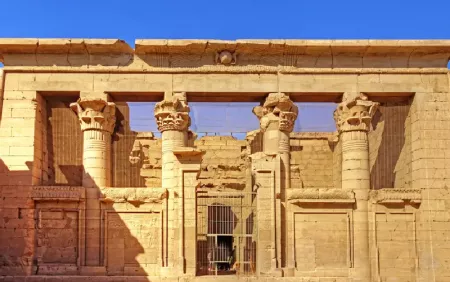
Kalabsha Temple, built under Emperor Augustus, was rescued from rising Nile waters in the 1960s and relocated block by block to New Kalabsha Island. Today, it remains a key UNESCO-recognized Nubian monument.

Soar above Luxor at sunrise in a hot air balloon and witness ancient temples, the Nile, and royal necropolises from the sky. This unforgettable experience offers breathtaking views and a unique perspective on Egypt’s timeless heritage.
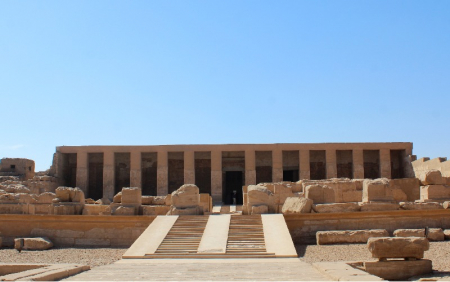
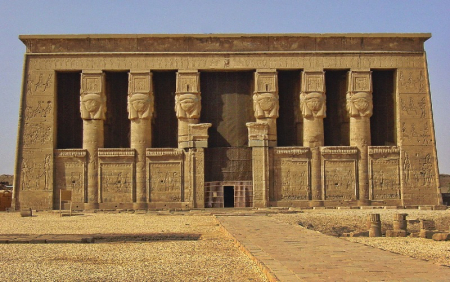
Explore the Temple of Hathor at Dendera, a remarkably preserved ancient Egyptian sanctuary dedicated to the goddess of love, music, and healing, renowned for its zodiac, vibrant reliefs, and astronomical ceilings.
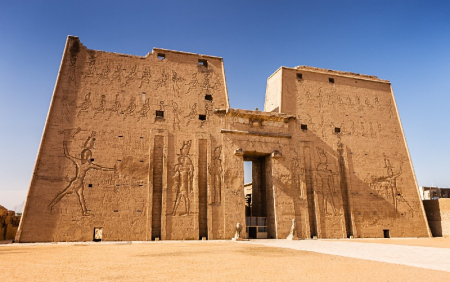
Visit the Temple of Horus at Edfu, a remarkably preserved Ptolemaic temple showcasing ancient Egyptian rituals, art, and architecture.
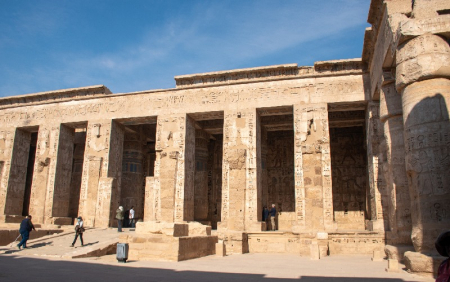
Explore Medinet Habu, Ramesses III’s temple, where history, religion, and artistry come alive on Luxor’s West Bank.
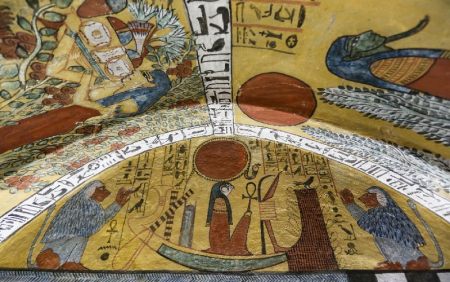
Deir el-Medina was home to the elite artisans who built and decorated Egypt’s royal tombs. Discover their homes, work, religion, and extraordinary daily life.
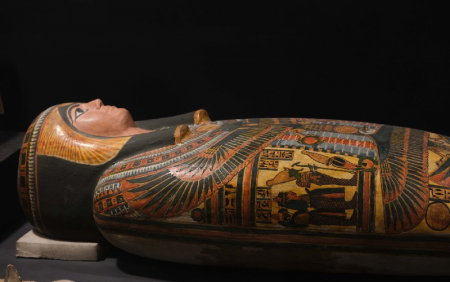
The Mummification Museum in Luxor showcases ancient Egyptian embalming, mummies, and artifacts, including Masaharta’s preserved remains and mummified animals.
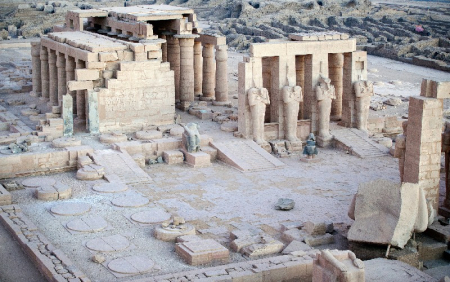
Discover the Mortuary Temple of Amenhotep III, once the largest in Thebes, famed for the Colossi of Memnon and ongoing restorations in Luxor.