
 Home
Home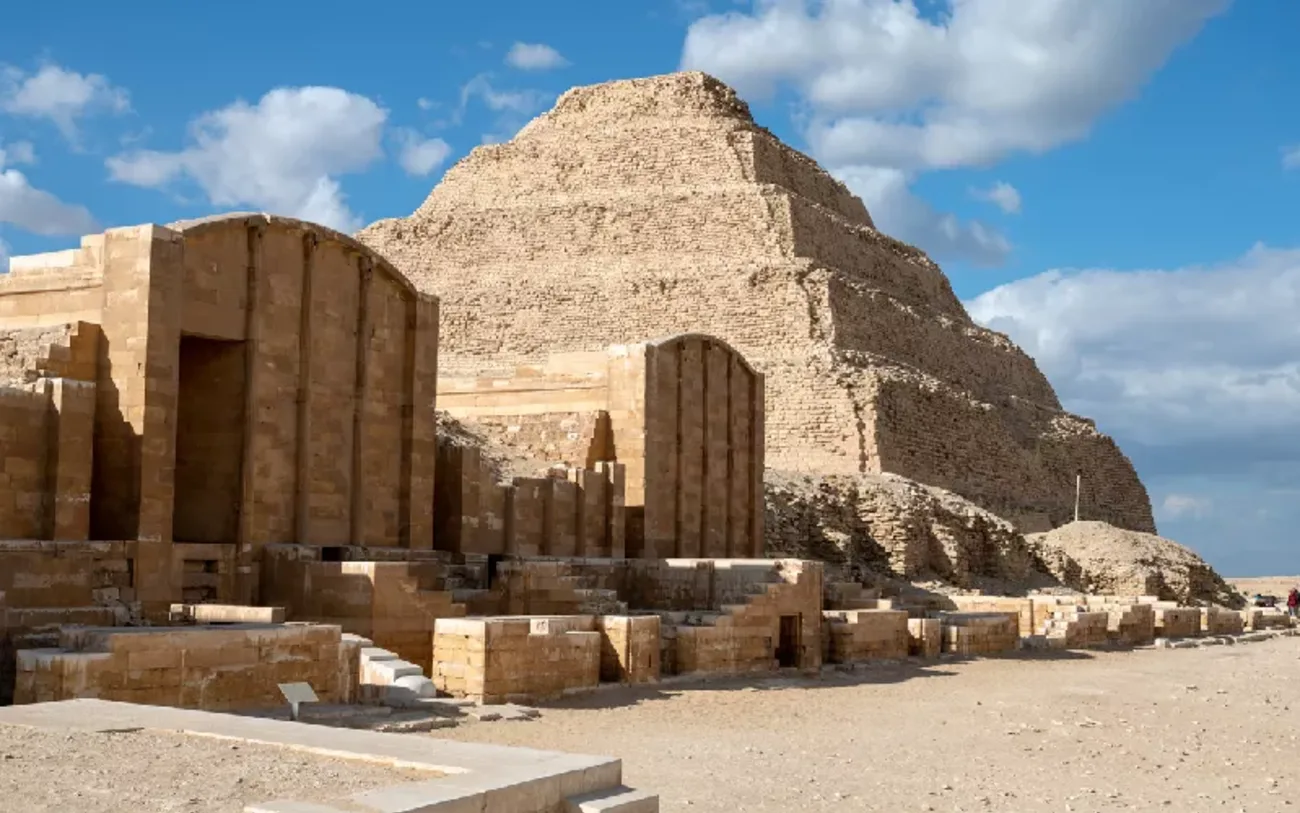
Before the Great Pyramids of Giza ever touched the sky, there was one monument that started it all - the Djoser Step Pyramid.
Rising 62.5 meters (205 feet) above the desert sands, this remarkable structure marks humanity’s first successful attempt at building a monumental stone pyramid. Located in the ancient burial ground of Saqqara, just northwest of Memphis, the pyramid stands as the birthplace of Egyptian monumental architecture.
What makes it even more fascinating is that it didn’t begin as a pyramid at all. It started as a simple rectangular tomb and gradually grew into the six-tiered stepped monument we see today. Once covered in shining white limestone, it must have glowed brilliantly under the desert sun.
After a careful 14-year restoration, the pyramid reopened to visitors in March 2020, making it possible once again to explore this ancient wonder up close. Today, it remains one of the most rewarding historical sites in Egypt for travelers who want to go beyond Giza and experience the roots of Egyptian civilization.
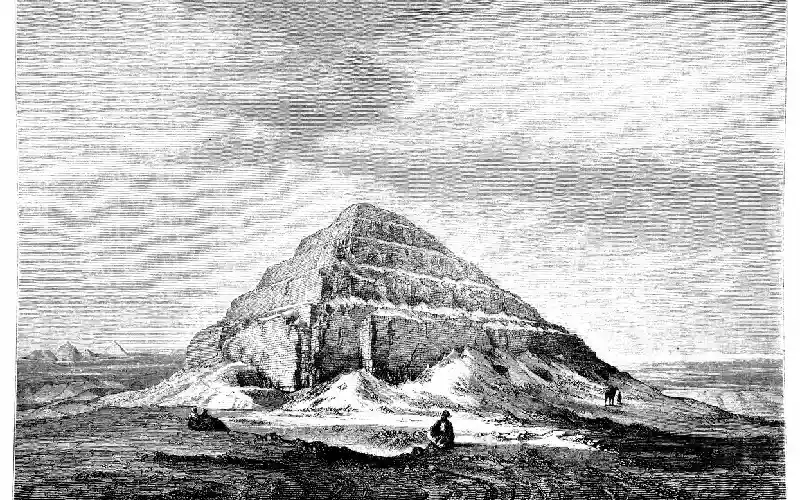
The pyramid stands 62.5 meters (205 feet) tall with six tiers. It was originally covered in shining white limestone that would have glowed brilliantly under the desert sun, making it visible from great distances.
The Origins of the Djoser Step Pyramid
The Step Pyramid represents a turning point in human history. It was the moment when builders moved from small mud-brick tombs to massive stone monuments designed to last forever.
Behind this breakthrough were two extraordinary individuals: a visionary king and a brilliant architect.
Who Was King Djoser
The man behind this project was King Djoser, also known as Netjerikhet, meaning “divine of body.” He ruled during Egypt’s 3rd Dynasty, around 2592–2566 BCE.
Djoser governed from Memphis and helped turn it into Egypt’s political and cultural center. His long and stable reign gave him the resources and confidence to attempt something no ruler had done before: building a monumental stone complex for his afterlife.
He was also known for:
- Leading military campaigns in the Sinai
- Strengthening Egypt’s borders
- Restoring temples during times of hardship
- Supporting agriculture and religious institutions
When Djoser died, he was buried deep beneath his pyramid, along with more than 40,000 stone vessels bearing the names of earlier kings—symbolizing his connection to Egypt’s royal past.
The pyramid was commissioned by King Djoser and designed by his chief architect Imhotep. Imhotep is considered the first architect in recorded history and revolutionized construction by replacing mud brick with solid limestone, changing architecture forever.
Imhotep: The Genius Behind the Pyramid
Every great monument needs a great mind. For Djoser, that mind belonged to Imhotep.
Imhotep was not born into royalty. He rose through talent and intelligence to become:
- Chief architect
- Vizier (chief minister)
- High priest of Ptah
- Physician and scholar
He is widely considered the first architect in recorded history.
His revolutionary idea was simple but bold: stack several traditional tombs (mastabas) on top of each other, each one smaller than the last. This created the world’s first pyramid shape.
Even more impressive, he replaced fragile building materials like mud brick and wood with solid limestone. This decision changed architecture forever.
So respected was Imhotep that his name was carved beside the king’s on the monument—something almost unheard of in ancient Egypt.
Centuries later, he was worshipped as a god of medicine and wisdom.
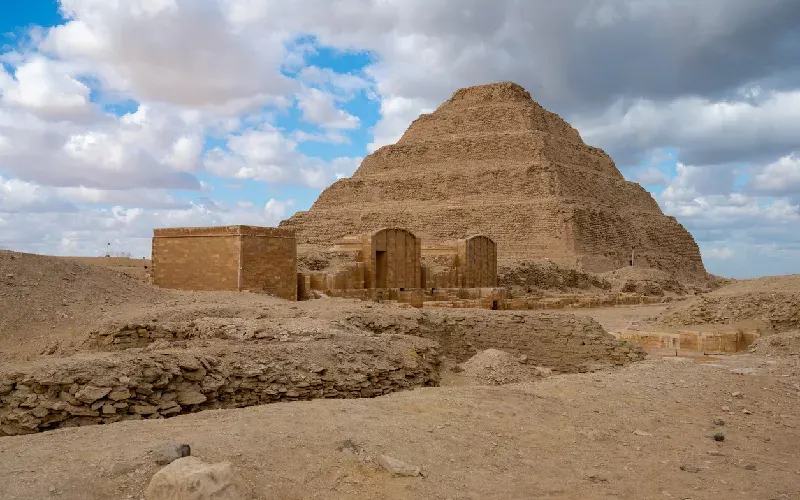
Imhotep was Djoser's chief architect, vizier (chief minister), high priest of Ptah, and a physician and scholar. He wasn't born into royalty but rose through talent and intelligence. His revolutionary idea of stacking mastabas created the world's first pyramid shape. Centuries later, he was worshipped as a god of medicine and wisdom.
Customize Your Dream Vacation!
Get in touch with our local experts for an unforgettable journey.
Plan Your TripWhy Saqqara Was Chosen
Djoser didn’t choose Saqqara by accident.
This vast burial ground had been used for royal tombs for generations. Earlier kings from the First and Second Dynasties were already buried here, making it a prestigious and sacred location.
Saqqara also had strong religious meaning. It was associated with Sokar, a god of death and rebirth, making it ideal for a royal afterlife complex.
From a practical point of view, the site was close enough to Memphis to dominate the skyline. The pyramid would constantly remind people of Djoser’s power and divine status.
After the Step Pyramid was built, many nobles chose to be buried nearby, hoping to share in its spiritual importance.
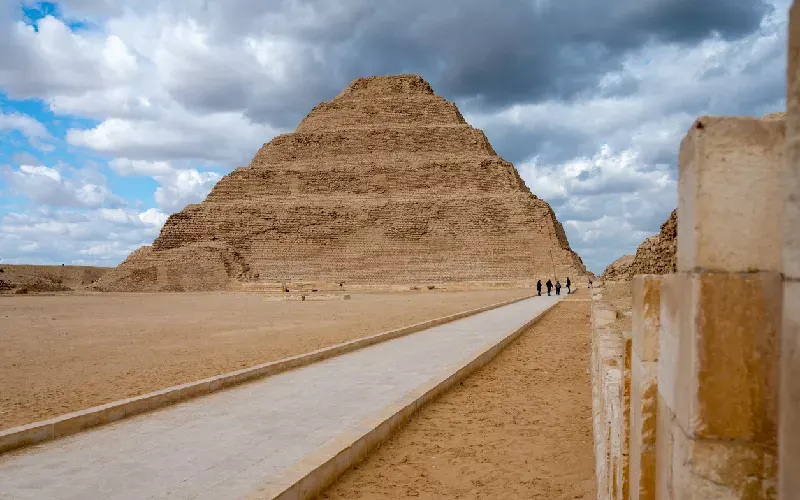
The Djoser Pyramid is located in Saqqara, the ancient burial ground just northwest of Memphis, about 30 kilometers south of Cairo. It stands as the centerpiece of a vast complex that served as Egypt's royal necropolis for centuries.
Exploring the Djoser Pyramid Complex
Walking into the Djoser complex feels like stepping into a different world.
After reopening in 2020, visitors can once again experience many of its original features.
The Outer Wall and Entrance
Your visit begins at a massive white limestone wall decorated with carved niches. It surrounds the entire complex like a protective shell.
Inside, you’ll enter through a stunning colonnade—a long corridor lined with 40 stone columns designed to look like bundled reeds. Even the ceiling mimics wooden beams, showing how Imhotep transformed traditional materials into stone.
The South Court and Ceremonial Areas
As you walk deeper, the Step Pyramid comes fully into view.
Nearby lies the South Court, where two curved stone markers once marked the space for royal festivals. These ceremonies symbolized the king’s strength and renewal.
The entire complex covers about 15 hectares (37 acres), making it one of the largest early royal compounds in Egypt.
Important Structures Inside
As you explore, you’ll find:
- The T-Temple and North/South Houses symbolizing united Egypt
- The South Tomb, linked to the king’s spiritual essence
- The Northern Temple aligned with stars and the afterlife
- The Heb-sed Court for eternal royal rituals
Each building had a specific religious and symbolic purpose.
Underground Tunnels
Beneath the pyramid lies a hidden world.
A vertical shaft descends 28 meters to the burial chamber. From there, more than 3.5 miles of tunnels, galleries, and storage rooms spread out underground.
Some areas are now open to visitors with special tickets, offering a rare glimpse into ancient burial practices.
Other Ways to Explore
Visitors can also enjoy:
- Camel rides around the perimeter
- Cultural workshops on hieroglyphics and mummification
- Guided tours explaining symbolism and history
Nearby attractions include:
- The Pyramid of Teti
- The Pyramid of Unas with early religious texts
- The Tomb of Idut
- The Tomb of Kagemni
You can also visit the Imhotep Museum, which explains how the pyramid was built and restored.
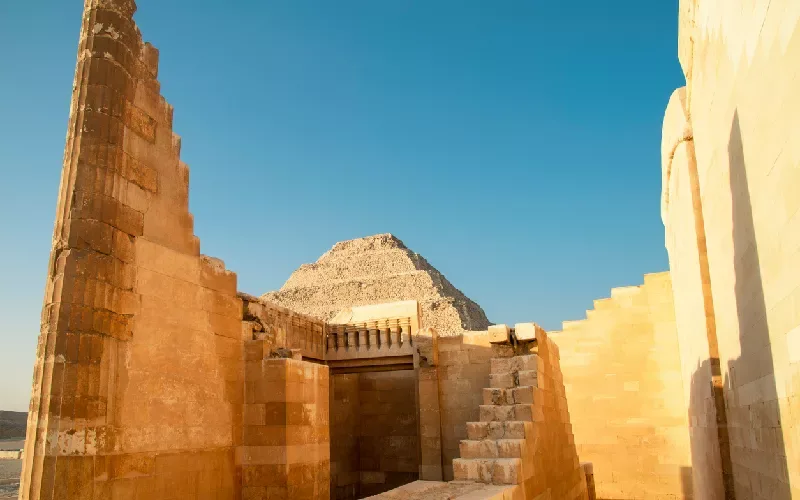
After a careful 14-year restoration project, the Djoser Pyramid reopened to visitors in March 2020. The restoration preserved the structure while making it safe for tourists to explore up close.
Djoser Pyramid Fast Facts
Here’s what makes the Djoser Pyramid truly special:
- World’s First Pyramid: The earliest large-scale stone monument, standing 62.5 meters tall
- Recently Restored: Reopened in March 2020 after 14 years of conservation
- Huge Complex: Covers 15 hectares with temples, courts, and tombs
- Visionary Team: Built by King Djoser and architect Imhotep
- Diverse Experiences: Underground tunnels, camel rides, and cultural workshops
This site represents the very beginning of monumental architecture and Egyptian pyramid building.
The Djoser Pyramid is located in Saqqara, the ancient burial ground just northwest of Memphis, about 30 kilometers south of Cairo. It stands as the centerpiece of a vast complex that served as Egypt's royal necropolis for centuries.
The Djoser Pyramid was built around 2592–2566 BCE during Egypt's 3rd Dynasty under the rule of King Djoser (also known as Netjerikhet). It represents humanity's first successful attempt at building a monumental stone pyramid.
It's called the Step Pyramid because of its distinctive six-tiered stepped design. Unlike the smooth-sided pyramids that came later, this structure resembles a giant staircase reaching toward the sky, created by stacking progressively smaller mastabas on top of each other.
The Djoser Pyramid marks the birthplace of Egyptian monumental architecture and represents the moment when builders moved from small mud-brick tombs to massive stone monuments. It's humanity's first large-scale stone structure and started the pyramid-building tradition that led to Giza's Great Pyramids.
When Djoser died, he was buried deep beneath his pyramid along with more than 40,000 stone vessels bearing the names of earlier kings. These vessels symbolized his connection to Egypt's royal past and demonstrated continuity with previous dynasties.
Visitors can enjoy camel rides around the perimeter, cultural workshops on hieroglyphics and mummification, and guided tours explaining the symbolism and history. Nearby attractions include the pyramids of Teti and Unas, tombs of Idut and Kagemni, and the Imhotep Museum.

The Great Pyramids of Giza, Egypt’s iconic monuments, showcase ancient engineering brilliance and remain the last wonder of the ancient world, continuing to fascinate visitors and researchers alike.

The Egyptian Museum in Cairo houses over 170,000 ancient artifacts, including Tutankhamun's complete collection and golden death mask. Opened in 1902, it's the world's largest repository of Egyptian antiquities.

Khan el-Khalili is Cairo’s legendary medieval bazaar, where centuries-old Islamic architecture, vibrant trade, and timeless cafés create a living cultural landmark.

The Great Sphinx of Giza, with its lion body and pharaoh head, represents ancient Egyptian artistry, symbolic power, and enduring cultural fascination.

Tanoura is a traditional Egyptian Sufi dance known for its colorful spinning skirts, spiritual rhythm, and deep roots in ancient mystic traditions.

Saqqara, Egypt's ancient necropolis, features Djoser's Step Pyramid—the world's oldest. Spanning 3,000 years, it preserves royal tombs and sacred animal burials.

The Valley Temple at Giza, built 2570 BCE by Khafre, features 16 granite columns and hosted sacred afterlife rituals. Explore Fourth Dynasty architecture.

The Citadel of Cairo is a historic medieval fortress and royal complex, showcasing centuries of Egyptian power, Mamluk architecture, and Islamic heritage, now preserved as a UNESCO World Heritage Site.

Khufu's Solar Boat is a 142-foot cedar vessel discovered 1954 near the Great Pyramid. Built without nails 4,500 years ago, it's now at Grand Egyptian Museum.

St. George Church in Old Cairo, founded 684 AD, features unique circular design, sacred healing relics & underground chapel linked to the Holy Family's refuge.

Pyramids Sound and Light Show transforms Giza into open-air theater with 50 minutes of narration, music & lighting bringing ancient Egyptian history alive.

The Djoser Pyramid at Saqqara is Egypt's first pyramid, built 2600 BCE by architect Imhotep. Standing 62.5m tall, it reopened to visitors in 2020.

The Hanging Church in Old Cairo is a 1,300-year-old Coptic sanctuary built on Babylon Fortress. Free entry, open daily 9 AM-5 PM, dress modestly required.
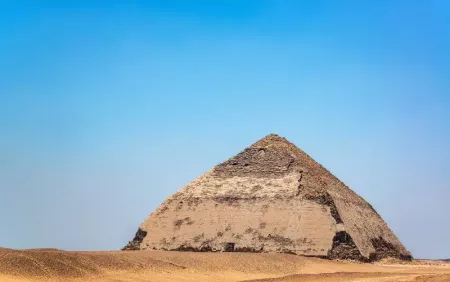
The Bent Pyramid at Dahshur features a rare bent profile created by ancient construction adjustments, offering insight into Egypt’s earliest attempts at smooth-sided pyramids.

Coptic Cairo features 4th-century churches and recent tomb discoveries revealing early Christian heritage. Explore the Hanging Church, Abu Serga & sacred sites.
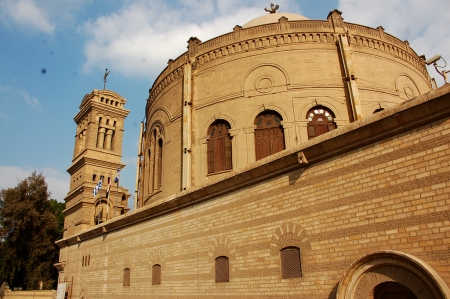
Saint Barbara’s Church in Coptic Cairo is one of Egypt’s oldest Christian monuments, dating back to the 5th–6th century. Known for housing the relics of Saint Barbara, the church reflects centuries of Coptic heritage, architectural evolution, and deep spiritual significance.

Explore the Fortress of Babylon, a major Roman fort in Old Cairo known for its strategic location, massive towers, and enduring historical significance.
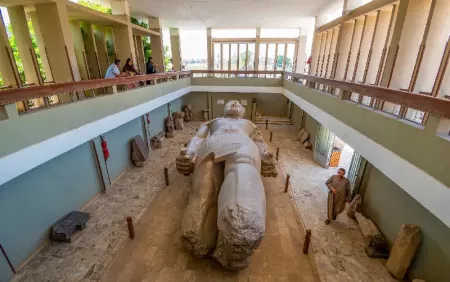
Memphis Necropolis is Egypt’s ancient royal burial site, home to pyramids, tombs, and monuments that reflect the early development of pharaonic civilization.
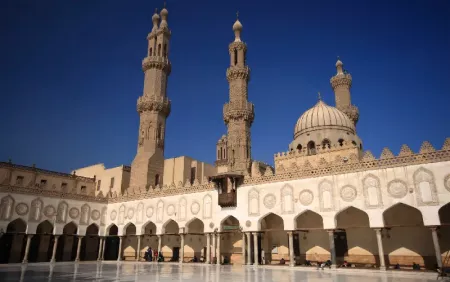
Al-Azhar Mosque is a landmark of Islamic scholarship and Fatimid architecture, home to the world’s second-oldest university and a symbol of Cairo’s spiritual heritage.
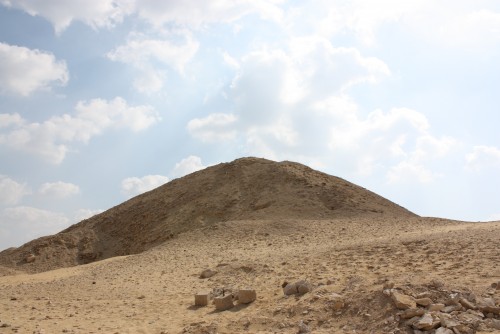
Teti’s Pyramid in Saqqara is an Old Kingdom monument built for the first king of the Sixth Dynasty. Known for its Pyramid Texts and unique mortuary chapel, it remains one of Egypt’s most historically important royal tombs.
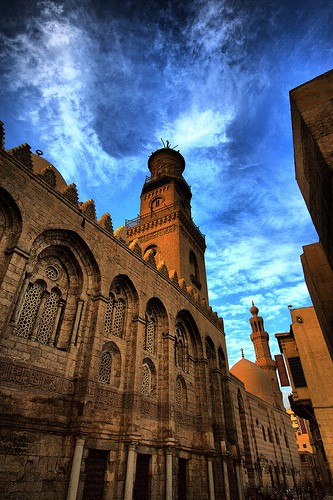
Al Muizz Street is one of Cairo’s oldest and most vibrant historic avenues, showcasing centuries of Islamic architecture. Lined with mosques, palaces, and bustling markets, it offers a captivating walk through Egypt’s medieval past.
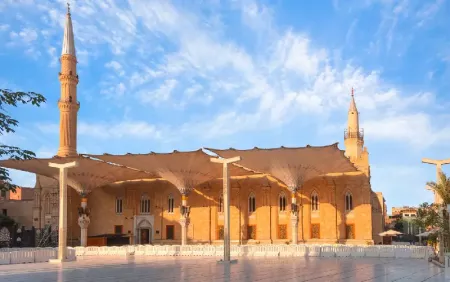
Al-Hussein Mosque is one of Cairo’s most sacred Islamic landmarks, built in 1154 and revered for housing the head of Imam Hussein. Located by Khan El-Khalili, it blends centuries of architectural heritage and remains a major pilgrimage site.
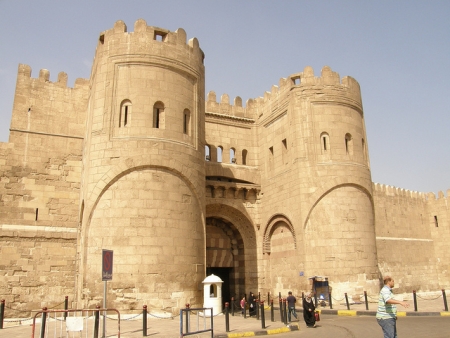
Bab al-Futuh is an 11th-century Fatimid gate in Old Cairo, famous for its massive round towers and strategic role in the city’s medieval fortifications.
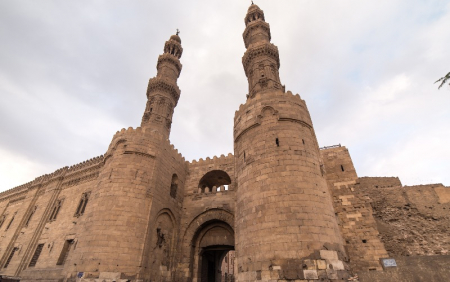
Bab Zuweila is one of Cairo’s last surviving medieval gates, built in 1092 CE by the Fatimid vizier Badr al-Jamali. Famous for its towering twin bastions, massive wooden doors, and later Mamluk minarets, it served as a defensive stronghold, execution site, and ceremonial gateway. Today, it stands as one of Cairo’s most iconic historic monuments.
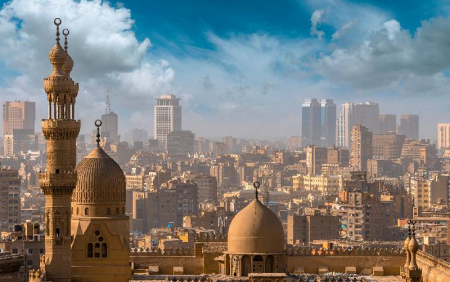
Al Rifai Mosque in Cairo blends Neo-Mamluk architecture with royal history. Completed in 1912, it serves as both a majestic mosque and mausoleum for Muhammad Ali’s family.
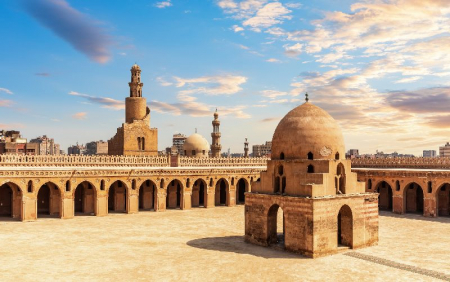
The Ibn Tulun Mosque, Cairo’s oldest well-preserved mosque, dates back to 879 CE. Famous for its vast square layout, intricate arches, and 128 ornate stucco windows, it remains a pinnacle of early Islamic architecture and a must-visit historical landmark.
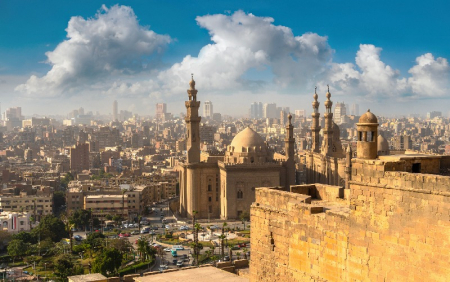
The Sultan Hassan Mosque, built in the 14th century, is a Bahri Mamluk architectural marvel in Cairo, renowned for its grand portal, extensive madrasas, and historic significance.

The Suez Canal, Egypt’s iconic waterway, connects Africa and Asia, handling thousands of ships yearly and shaping international trade.
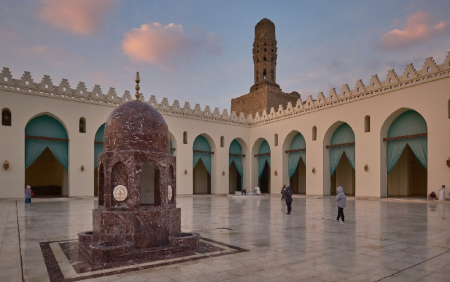
Al-Hakim Mosque, Cairo, is a stunning Fatimid-era mosque built between 990–1013 CE. Famous for its grand courtyard, distinctive minarets, and rich history, it remains a key cultural and religious landmark.
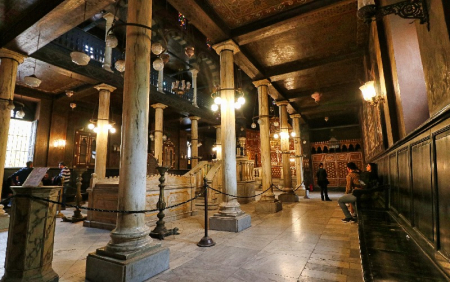
The Ben Ezra Synagogue, founded in the 11th century in Old Cairo, is Egypt’s oldest Jewish monument and the discovery site of the renowned Cairo Geniza.